
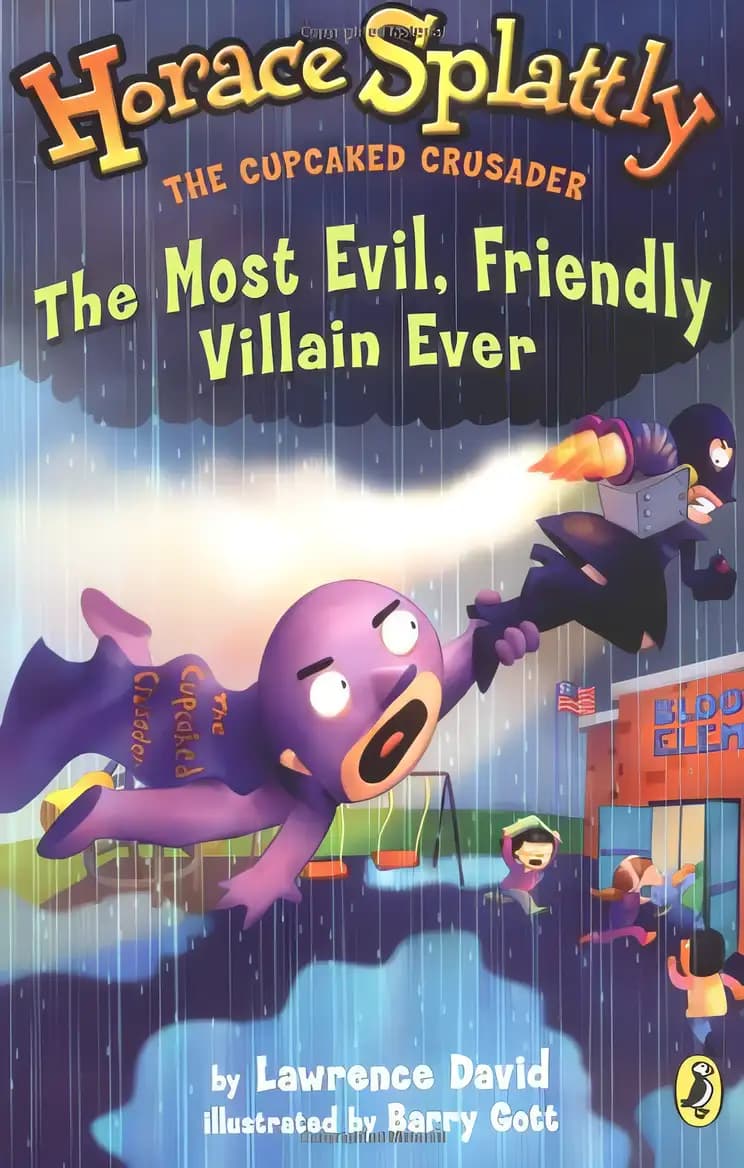
The Most Evil, Friendly Villain Ever (Horace Splattly, the Cupcaked Crusader)
#6 in Horace Splattly Series
on Goodreads (25)
What’s inside...
In this newest installment of the action-packed adventures of Horace Splattly, the ten-year-old turned superhero, recess at Blootinville Elementary is under attack! A mysterious raincloud appears every day-only over the playground. To make matters worse, no recess means that Horace can't escape the attentions of Myrna Breckstein, who wants to be his girlfriend. But no one knows who the evil villain ruining recess could be. Can Horace solve the mystery and save the playground in time, or is the school year doomed?
Character compass
Horace Splattly
Melody Splattly
Discussion points
How do you think Horace feels when he transforms into the Cupcaked Crusader?
What would you do if you had Horace’s superpowers for a day?
Why is it important for the Cupcaked Crusader to keep his identity a secret?
Can you think of a time when something small turned out to be more powerful than it looked?
Tip: Role play these questions
To engage your child in a meaningful discussion about 'The Most Evil, Friendly Villain Ever', consider using expressive questions that relate directly to their personal experiences and imagination. This approach not only makes the conversation more relatable but also encourages deeper thinking about the characters and the storyline. Emphasize the fun and quirky aspects of the book to maintain your child’s interest, and validate their responses to make them feel confident about their opinions and thoughts.
Key lessons
Example Lesson: Understanding the importance of empathy
Explanation: Throughout the book, Horace Splattly navigates various situations that teach him to understand and empathize with others, including those who initially appear to be villains.
Real-World Application: Children can learn the value of trying to understand others' perspectives, promoting a more empathetic approach when they face conflicts or disagreements in school or at home.
Example Lesson: The power of creativity and ingenuity
Explanation: Horace often uses his inventive skills to solve problems, showing that creativity isn't just about art but also about thinking outside the box to handle real-life challenges.
Real-World Application: This encourages children to apply creative problem solving in their daily activities, whether it's in inventing games, finding new ways to do tasks, or overcoming obstacles.
Example Lesson: Responsibility and the consequences of actions
Explanation: As Horace faces the consequences of his choices, both good and bad, the story teaches that actions have consequences, and being responsible is key.
Real-World Application: Children are prompted to consider the effects of their decisions on themselves and others, guiding them towards more responsible behavior at home and at school.
Example Lesson: Importance of teamwork
Explanation: The protagonist learns that working together with others, even those who are different from him, can lead to successfully overcoming adversities.
Real-World Application: This lesson helps children understand the importance of cooperative teamwork and how combining strengths with others can help solve problems more efficiently.
Example Lesson: Standing up for what is right
Explanation: Horace often takes a stand against the 'villain,' illustrating the importance of defending what one believes to be right, despite challenges or opposition.
Real-World Application: This encourages children to stand up for their beliefs and values in real-world scenarios, such as in their interactions with peers or in their community.