
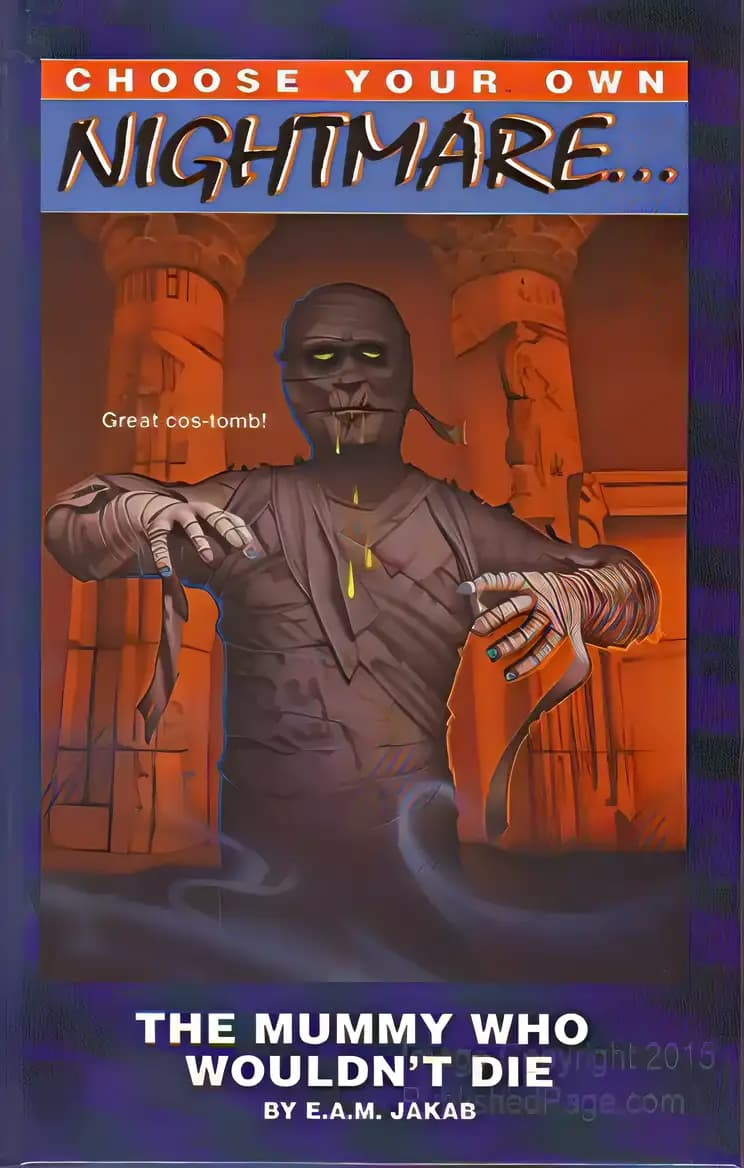
The Mummy Who Wouldn't Die (Choose Your Own Nighmare)
#7 in Choose your own adventure Series
What’s inside...
The reader's decisions control the course of an adventure in which a sacred amulet must be returned to a museum mummy before the mummy notices that it is missing.
Discussion points
How would you react if you were in the main character's shoes and faced similar choices?
What do you think the mummy represents in the story? Why?
How do the different choices in the book change the story's outcome?
Which decision in the book was the most difficult, and why do you think so?
What did you learn about courage and fear from this story?
Tip: Role play these questions
Before reading, set the stage by asking your child what they know about mummies and what they would do if they met one.
As you go through the book, pause at key decision points and ask your child what they would choose and why.
After finishing the book, discuss the consequences of the chosen paths and relate them to everyday decisions.
Encourage your child to express their feelings about the suspense and mystery elements in the story.
Link the themes of the book to personal experiences where your child had to make tough choices.
Key lessons
Example Lesson: Decision-making skills
Explanation: This interactive book requires children to make choices that determine the story’s outcome, teaching them the impact of their decisions.
Real-World Application: Children learn to think ahead and weigh options before making decisions in their daily interactions and challenges.
Example Lesson: Understanding consequences
Explanation: Each choice in the book leads to different consequences, helping children understand that their actions have direct outcomes.
Real-World Application: This will help them grasp the concept of cause and effect, enhancing their ability to predict and accept the outcomes of their actions.
Example Lesson: Problem-solving skills
Explanation: The book presents various challenges and problems that the reader must navigate, encouraging strategic thinking and creativity.
Real-World Application: Children can apply these problem-solving techniques in academic settings or personal situations, developing resilience and resourcefulness.
Example Lesson: Coping with fear
Explanation: The narrative involves suspenseful and eerie scenarios where the reader has to make brave choices.
Real-World Application: This can help children learn to manage their fears and stay calm under pressure in real-life situations.
Example Lesson: Responsibility
Explanation: By being responsible for the story’s direction, children learn the value of responsibility and accountability for their choices.
Real-World Application: This encourages children to take ownership of their tasks and decisions, whether at school or at home.