
The Night Diary
on Goodreads (19,528)
What’s inside...
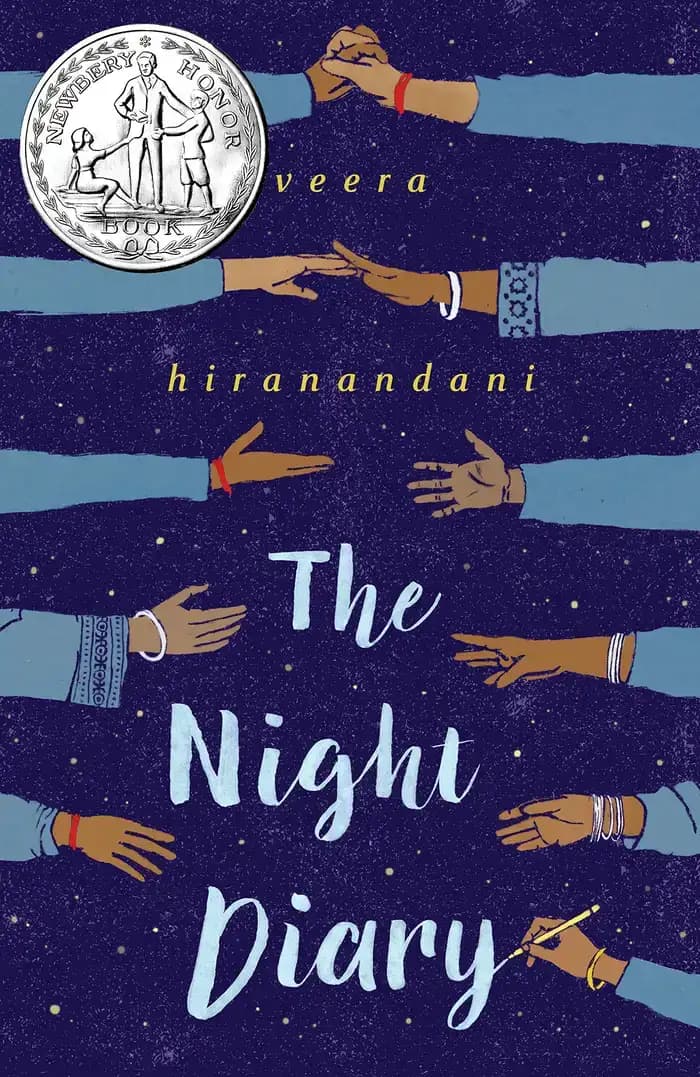
Twelve-year-old Nisha's family is forced to flee their home in what is now Pakistan at the time of the 1947 Partition of India. The book is in the form of letters written by Nisha to her deceased mother where she narrates her experiences, fears and longings. As Nisha and her family embark on a perilous journey to find a new home, she grapples with her mixed heritage and the loss of her mother, finding solace in writing letters to her. The story provides a personal and poignant glimpse into a significant historical event. The book was recognized as a 2019 NEWBERY HONOR BOOK.
Age
10-12
Length
272 pages
Text complexity
Character compass
Nisha
Amil
Dadi
Kazi
Papa
Discussion points
How do you think Nisha felt when she had to leave her home? Can you relate to her feelings in any way?
Why do you think it's important for Nisha to write letters to her mother?
What does the partition of India teach us about the impact of political decisions on individual lives?
How do the characters in the book show resilience in the face of challenges?
If you could speak to Nisha, what advice or message would you want to give her?
Tip: Role play these questions
Start by sharing your own reflections on the book to create an open environment where your child feels comfortable sharing their thoughts.
Ask your child to draw parallels between Nisha’s experiences and anything from their own life, fostering empathy and personal connection.
Discuss the historical context of the book beforehand to provide your child with a clearer understanding of the storyline.
Encourage your child to think about what they would do in Nisha's situation, enhancing their problem-solving and empathy skills.
Use the themes of the book such as family, resilience, and hope as conversation starters during your family reading time.
Key lessons
Example Lesson: Empathy and understanding
Explanation: The protagonist, Nisha, writes letters to her deceased mother to process her feelings about the India-Pakistan partition, showing deep empathy towards people on both sides of the conflict.
Real-World Application: Children can learn to understand and respect different perspectives and historical contexts, fostering empathy and compassion in their interactions with diverse groups.
Example Lesson: Resilience in the face of adversity
Explanation: Nisha and her family face numerous challenges during their migration due to the partition, yet she remains hopeful and adapts to the changing situations.
Real-World Application: This teaches children the importance of resilience and staying hopeful, equipping them to handle tough situations in their own lives with perseverance.
Example Lesson: Importance of family and support systems
Explanation: Throughout the turmoil, Nisha's relationship with her brother and the support from her family plays a crucial role in her emotional stability and sense of security.
Real-World Application: Children learn the value of family bonds and the importance of supporting each other during difficult times, promoting strong familial relationships and emotional health.
Example Lesson: Identity and self-discovery
Explanation: As Nisha writes to her mother, she explores her identity straddling her Hindu and Muslim heritage, learning to accept all parts of who she is.
Real-World Application: This encourages children to explore and embrace their own identities, respecting their background and that of others, which is essential in building self-esteem and mutual respect in society.