
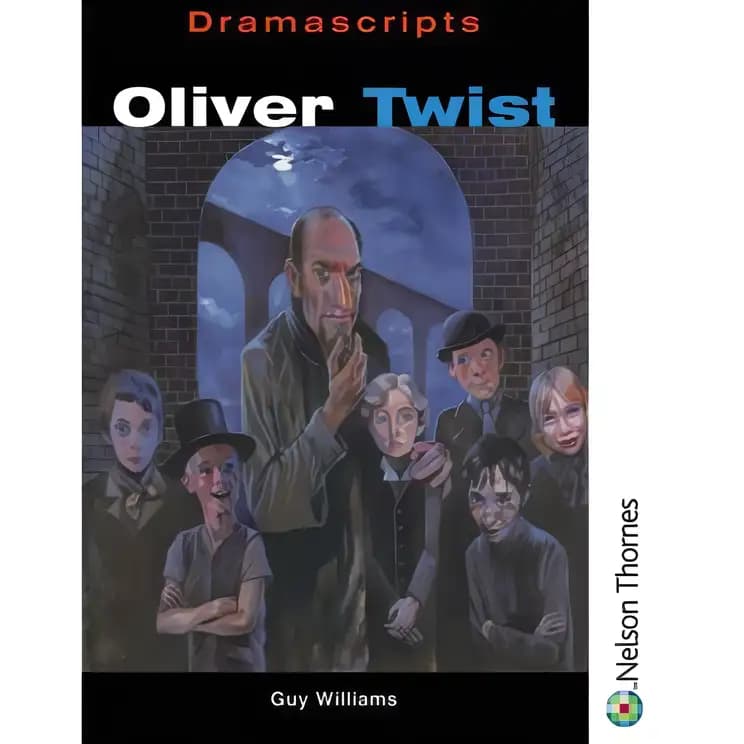
The Play Of Oliver Twist (Heinemann Plays For 11-14)
The New windmill series
on Goodreads (25)
What’s inside...
Dickens' irresistible portrayal of poverty, cruelty and crime in Victorian Britain tells of Oliver's arrival in London, where he falls under the influence of Fagin, a gang of young thieves and the irrepressible Artful Dodger. Extracts from the novel allow for comparative study between the original and the play. There are 30 reading parts.
Series reading
Non-Sequential
Age
8-10
Length
457 pages
Text complexity
Character compass
Oliver Twist
Nancy
The Artful Dodger (Jack Dawkins)
Mr. Brownlow
Mr. Bumble
Bill Sikes
Fagin
Discussion points
How do you think Oliver felt when he asked for more food, and why is that moment significant?
What differences and similarities do you notice between yourself and Oliver?
Why do you think the author chose to portray the characters like Fagin and Bill Sikes the way he did?
What lessons can we learn from Oliver’s experiences and decisions throughout the play?
How do the settings in the play influence the story that unfolds? Discuss your thoughts on this.
Tip: Role play these questions
To foster a deeper understanding of the story, relate the themes of the play to situations your child might face today. Discuss the implications of standing up for oneself like Oliver, and the importance of empathy and kindness. Encourage your child to express their feelings about the characters and their actions, and validate their opinions to promote a sense of security in sharing. Use examples from the book to discuss topics like resilience, integrity, and the consequences of choices.
Key lessons
Example Lesson: Empathy and Compassion
Explanation: Oliver Twist's experiences of poverty and injustice highlights the importance of understanding and compassion towards others. Through his interactions with various characters, children see the impact of kindness in a harsh world.
Real-World Application: Children can apply this lesson by showing kindness to peers who may be different from them or in need, fostering a supportive community environment.
Example Lesson: The Consequences of Choices
Explanation: Throughout the play, characters make choices that lead to significant consequences, both good and bad. This portrayal helps children understand that actions have effects.
Real-World Application: Children learn to think about the outcomes of their actions, such as sharing with others leading to friendships, or lying leading to loss of trust.
Example Lesson: Resilience and Perseverance
Explanation: Oliver’s journey is filled with challenges, yet he remains resilient and continues to strive for a better life. This resilience teaches children the importance of perseverance in the face of adversity.
Real-World Application: This lesson encourages children to keep trying despite difficulties, whether in school tasks, sports, or personal goals.
Example Lesson: The Importance of Seeking Help
Explanation: In the play, Oliver benefits from asking for help at crucial moments, demonstrating that seeking assistance is not a sign of weakness but a step towards change.
Real-World Application: Children can learn to ask for help from teachers, family, or friends when they face problems, understanding that it is a part of learning and growing.
Example Lesson: The Impact of Social Justice
Explanation: The play sheds light on the disparities between different social classes and advocates for a fairer society. It encourages awareness and action towards social equity.
Real-World Application: Children can participate in community service or school discussions about fairness, learning early on about their role in building a just society.