
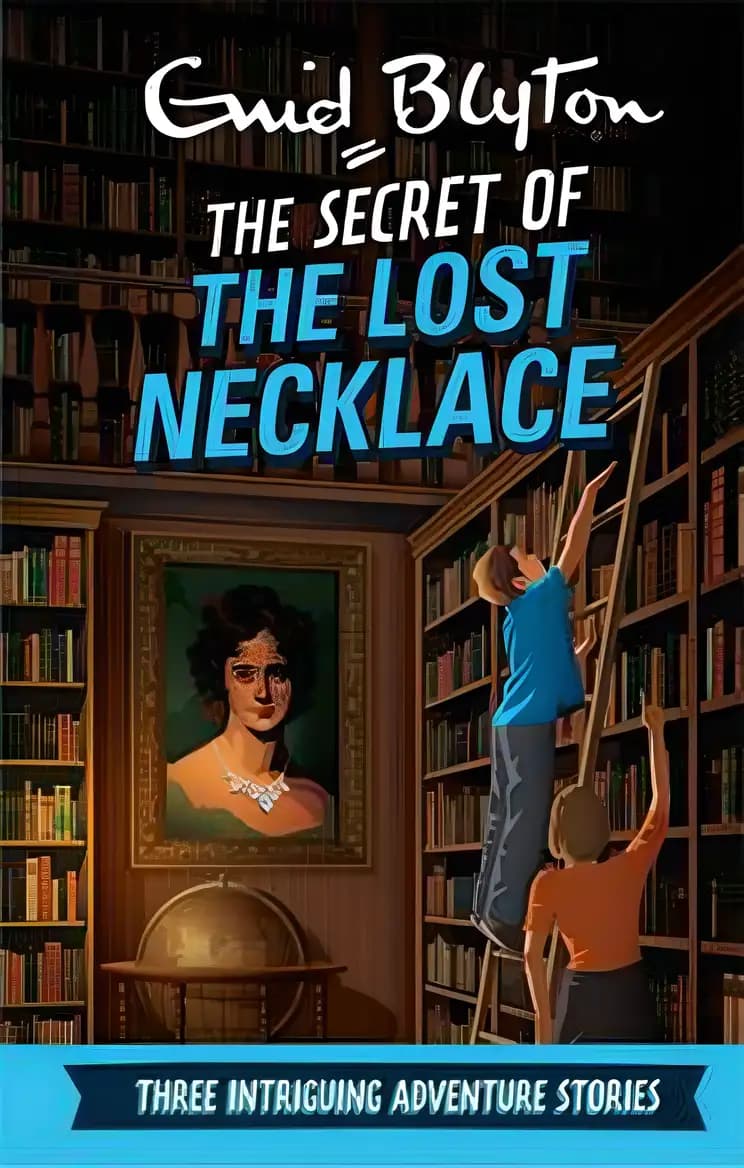
The Secret of the Lost Necklace: Three Intriguing Adventure Stories (Enid Blyton: Adventure Collection)
Paris-Chien Adventure series
on Goodreads (86)
What’s inside...
When Bob and Mary hear of a mysterious family legend about a hidden necklace, they are determined to solve the puzzle. But their older cousin Ralph is not all that he appears to be, and the search for a secret passage takes a frightening turn. This book also includes two other stories, 'Mischief at St Rollo's' and 'The Children of Kidlinnin', which are set in adventurous and wartime contexts, respectively.
Series reading
Non-Sequential
Age
8-12
Length
272 pages
Text complexity
Character compass
Frederick Algernon 'Fatty' Trotteville
Margaret 'Daisy' Daykin
Elizabeth 'Bets' Hilton
Philip 'Pip' Hilton
Laurence 'Larry' Daykin
Mr. Theophilus Goon
Discussion points
What do you think is the most important lesson the characters learned during their adventure in 'The Secret of the Lost Necklace'?
How did the characters' friendship change or grow throughout the story?
If you were part of the adventure, what role would you choose to play and why?
What would you do if you found a mysterious necklace? How would you handle the situation?
How do the characters solve problems together? Can you think of a time when you worked with friends to solve a problem?
Tip: Role play these questions
Encourage your child to put themselves in the characters' shoes to better understand their motivations and feelings. Use the story as a springboard to discuss the importance of teamwork and friendship. Highlight moments in the book where the characters make important decisions, and relate these to real-life choices your child may face. Lastly, celebrate your child’s responses to foster a love for critical thinking and lively discussion.
Key lessons
Example Lesson: Teamwork and Collaboration
Explanation: The characters in 'The Secret of the Lost Necklace' often work together to solve mysteries and overcome obstacles. Their successes are largely attributed to their ability to collaborate effectively and leverage each other’s strengths.
Real-World Application: Children can apply this lesson by participating in group activities at school or in sports, learning to cooperate and value each other’s input and strengths to achieve a common goal.
Example Lesson: Problem Solving
Explanation: Throughout the stories, the young protagonists encounter numerous problems that require critical thinking and creativity to solve. This encourages an analytical approach to challenges.
Real-World Application: This can encourage children to approach their own real-life challenges with patience and innovation, whether it’s solving a difficult math problem or resolving a conflict with a peer.
Example Lesson: Curiosity and Exploration
Explanation: The characters’ adventurous spirits lead them to explore new places and ask questions, driving the plot and their personal growth.
Real-World Application: Children are encouraged to be curious about the world around them, ask questions, and actively seek knowledge, both academically and in their everyday interactions.
Example Lesson: Integrity and Honesty
Explanation: Key moments in the book show characters facing moral dilemmas where they must choose honesty over the easier path of deceit, reinforcing the importance of integrity.
Real-World Application: This lesson highlights the importance of being truthful in real-life scenarios, such as admitting to mistakes and being honest in their dealings with friends and family members.
Example Lesson: Courage and Bravery
Explanation: The young characters often face fears and take risks to help others, showing that bravery is not the absence of fear but acting in spite of it.
Real-World Application: This can inspire children to face their own fears and stand up for what is right, whether it means trying new activities or defending a classmate.