
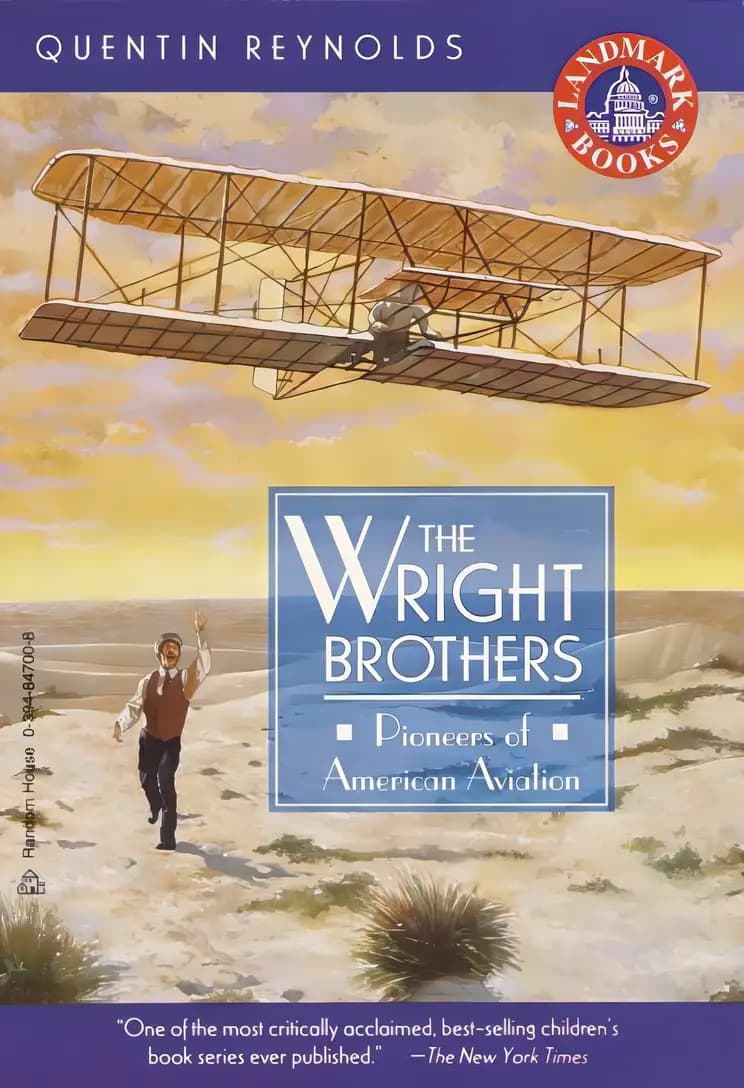
The Wright Brothers: Pioneers of American Aviation (Landmark Books)
#10 of 11 in Landmark Books Series
What’s inside...
Young Orville and Wilbur Wright loved building things, from the fastest sled in town to the highest-flying kite. As they grew up, they learned about mechanics by fixing bicycles, and studied math and physics. On December 17, 1903, Orville took flight in the world's first flying machine, marking a significant advancement in technology. The story follows their journey as self-taught bicycle mechanics who believed in their dream to fly and built the world's first successful airplane.
Character compass
Wilbur Wright
Orville Wright
Katharine Wright
Octave Chanute
Discussion points
How do you think the Wright brothers felt when they finally got their airplane to fly?
Why do you think perseverance was important for the Wright brothers' success?
What impact do you believe the Wright brothers had on today's world?
Can you think of a time when you had to keep trying something difficult, like the Wright brothers did?
What other inventions do you think were influenced by the success of the airplane?
Tip: Role play these questions
Encourage your child to relate personal experiences of overcoming challenges to the Wright brothers' perseverance.
Discuss the importance of innovation and how it shapes our everyday life, linking it back to the Wright brothers' invention.
Ask your child to imagine and describe what life might have been like without airplanes, fostering critical thinking about the impact of the Wright brothers.
Create a family brainstorming session where you think of other inventors and their contributions to modern society, connecting them with the narrative of the book.
Key lessons
Example Lesson: Perseverance leads to success
Explanation: The story illustrates how the Wright Brothers encountered many failures and setbacks before successfully flying the first airplane. Their determination and persistence in the face of challenges were crucial to their achievements.
Real-World Application: Children can learn to embrace challenges and persist in their endeavors, whether in academics, sports, or personal projects, understanding that persistence often leads to success.
Example Lesson: Innovation and creativity are key to solving problems
Explanation: The book showcases the Wright Brothers' inventive approach to overcoming the problems of powered flight. Their ability to think outside the box and develop creative solutions was essential.
Real-World Application: Kids can be encouraged to think creatively to solve problems and innovate, understanding that many modern conveniences and technologies arose from creative thinking.
Example Lesson: Teamwork is valuable
Explanation: Throughout their journey, the Wright Brothers worked closely together, combining their skills and knowledge to accomplish their goal. This collaboration was pivotal in their success.
Real-World Application: Children can learn the importance of working with others towards common goals, whether on school projects, team sports, or family activities, recognizing that teamwork often yields better results than working alone.
Example Lesson: Learning from failure
Explanation: The narrative details the numerous unsuccessful attempts before achieving flight, teaching that failures are stepping stones to success.
Real-World Application: This story can help children understand that mistakes and failures are part of learning and growing, and that they should not be discouraged by setbacks but learn from them.
Example Lesson: Curiosity drives discovery
Explanation: The Wright Brothers were deeply curious about flight, which fueled their dedication and commitment to exploring uncharted territory.
Real-World Application: Encouraging curiosity in children can lead them to explore new areas of interest and knowledge, fostering a lifelong love of learning and discovery.