
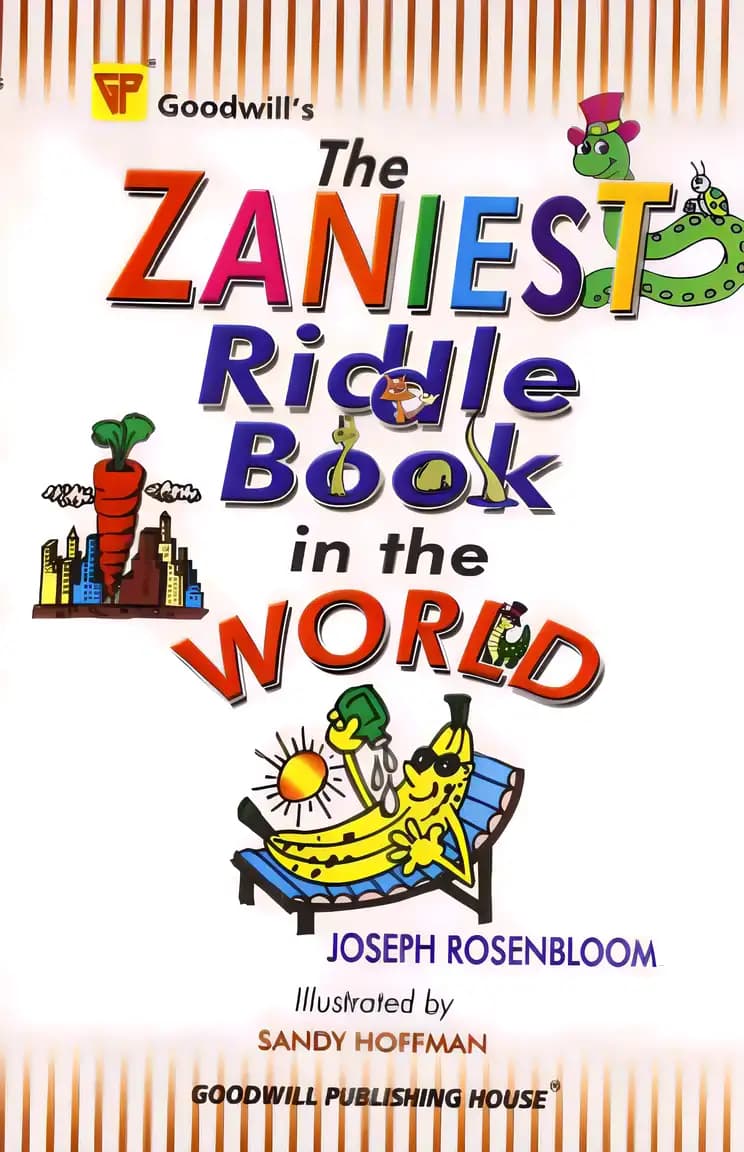
The zaniest riddle book in the world
on Goodreads (18)
What’s inside...
The Zaniest Riddle Book in the World by Joseph Rosenbloom is a collection of over 900 humorous and whimsical riddles designed to entertain and challenge readers. It features clever wordplay, puns, and brain teasers that promote lateral thinking and creativity. Suitable for all ages, this book is ideal for family fun, classroom activities, and individual enjoyment. At 128 pages with 86 black and white illustrations, it is praised by educators and loved by students, making it a delightful resource for engaging with language and problem-solving skills.
Age
9-12
Length
128 pages
Text complexity
Discussion points
What was the silliest riddle in the book, and why did it make you laugh?
If you could create your own riddle, what would it be about?
How do riddles make you think differently than regular questions?
Which riddle was the most challenging, and how did it feel when you figured it out?
Can you think of a situation in your daily life where you could use a riddle to make someone smile?
Tip: Role play these questions
Share your favorite childhood riddles with your child, connecting your experiences with theirs.
Encourage your child to create their own riddles based on their favorite animals or hobbies, fostering creativity.
Discuss the different types of riddles in the book and explore which ones require more creative versus logical thinking.
Celebrate the successes when they solve a difficult riddle, and reinforce that it's okay to be stumped sometimes—it's part of the fun!
Consider creating a 'riddle of the day' routine, where both you and your child take turns sharing a riddle.
Key lessons
Example Lesson: Language Skills Development
Explanation: Through engaging riddles, children enhance their language skills, vocabulary, and comprehension.
Real-World Application: Children can apply advanced language skills in school assignments, effectively communicate their ideas, and understand complex concepts.
Example Lesson: Problem-Solving Skills
Explanation: Solving riddles requires logical thinking and problem-solving, encouraging children to think critically.
Real-World Application: These skills help children in mathematical concepts, scientific investigations, and real-life problem solving.
Example Lesson: Humor Appreciation
Explanation: The witty and humorous nature of riddles in the book instills a sense of humor, aiding in social interactions.
Real-World Application: Understanding and sharing humor can improve children's social skills and peer relationships.
Example Lesson: Creativity and Imagination
Explanation: Thinking of unexpected answers to riddles boosts creative thinking and imagination.
Real-World Application: Enhanced creativity leads to better adaptability in tasks and the ability to devise unique solutions in various situations.
Example Lesson: Cognitive Flexibility
Explanation: Deciphering riddles enhances cognitive flexibility, allowing children to shift their thinking and view problems from multiple perspectives.
Real-World Application: This flexibility is crucial in adapting to new information and environments, which is vital in both academic and personal growth.