
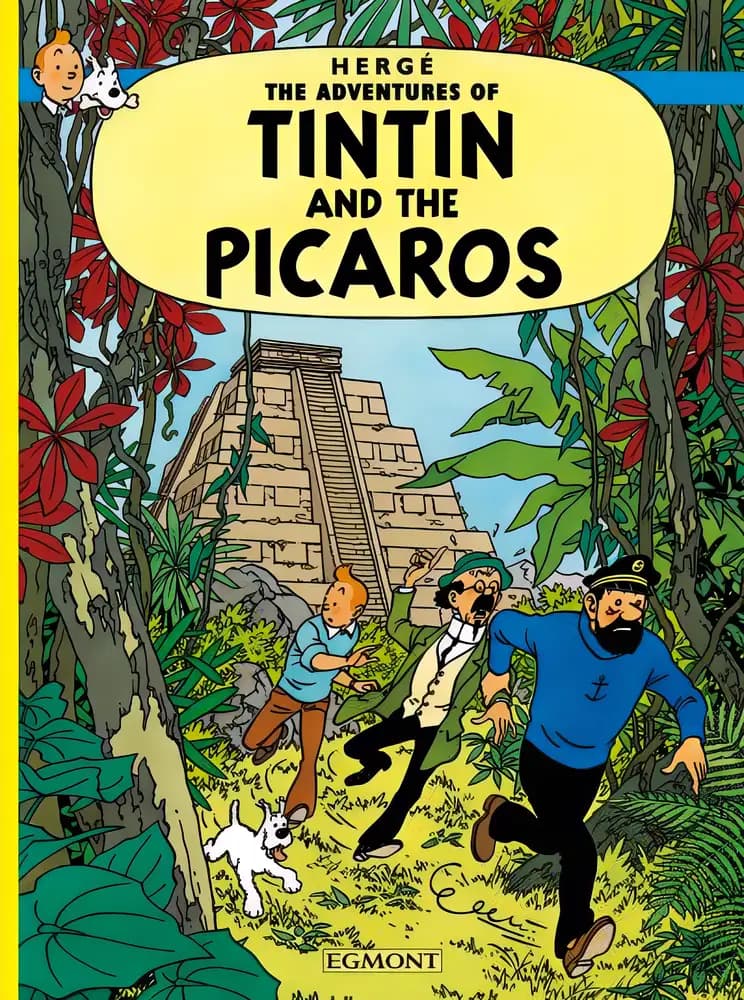
Tintin and the Picaros (The Adventures of Tintin)
#23 of 31 in Tintin Series
on Goodreads (12,076)
What’s inside...
In 'Tintin and the Picaros,' Tintin, Captain Haddock, and Professor Calculus travel to the fictional South American country of San Theodoros after their friend Bianca Castafiore is falsely accused of plotting to overthrow the dictatorship of General Tapioca. Upon arrival, they are drawn into a complex political situation involving the revolutionary group known as the Picaros, led by General Alcazar. Tintin devises a non-violent plan to help Alcazar overthrow Tapioca without bloodshed. With clever tactics, including spiking the Picaros' alcohol supply to keep them sober and disguising themselves in the carnival, Tintin and his friends successfully aid in the peaceful coup. The story ends with the establishment of a new government and the promise of democratic reforms, as Tintin and his companions return home.
Character compass
Tintin
General Alcazar
Professor Cuthbert Calculus
Captain Haddock
Bianca Castafiore
General Tapioca
Colonel Sponsz
Thomson & Thompson
Captain Archibald Haddock
Professor Calculus
Snowy
Discussion points
What do you think motivates Tintin to go on his adventures?
How do Tintin's actions show his values of bravery and friendship?
Do you think there are good and bad choices made by characters in the story? Can you give some examples?
What do you think you would have done if you were in Tintin's place during some of the challenging moments?
How can we relate the settings in the story to real-world locations and cultures?
Tip: Role play these questions
Encourage your child to think deeply about the characters’ motivations, and how they might relate to their own life experiences. Praise their insights and gently guide them to consider different perspectives. Use real-world analogies to help them connect with the diverse settings and cultures represented in the story. Finally, foster empathy by discussing the moral decisions characters face, highlighting the importance of values like courage and loyalty.
Key lessons
Example Lesson: The importance of bravery and courage
Explanation: In 'Tintin and the Picaros', Tintin exhibits bravery when he decides to help his friends overthrow a corrupt regime, despite the dangers involved.
Real-World Application: Children can learn to stand up for what is right and face challenges with courage, whether it’s dealing with a school bully or speaking out against unfairness in their daily activities.
Example Lesson: The value of loyalty and friendship
Explanation: Throughout the story, Tintin remains loyal to his friends, risking his own safety to aid them and sticking by their side in challenging times.
Real-World Application: This teaches children the importance of being a dependable and faithful friend in maintaining lasting relationships.
Example Lesson: The impact of cultural awareness
Explanation: Tintin’s journey illustrates the importance of respecting and understanding different cultures, as he navigates through the political and social environments of a fictional South American country.
Real-World Application: Children are encouraged to learn about and respect diverse cultures, which can lead to more inclusive behavior and better social interactions in multicultural settings.
Example Lesson: Critical thinking and problem-solving
Explanation: Tintin often faces complex problems that require critical thinking and creativity to resolve, like strategizing to liberate his friends.
Real-World Application: This promotes the development of problem-solving skills in children, helping them to think critically and creatively in their approach to obstacles.
Example Lesson: Consequences of political corruption
Explanation: The story sheds light on the effects of corrupt leadership and how it harms the citizens of the country, sparking Tintin’s involvement to help the oppressed.
Real-World Application: This can serve as a foundation for children to understand the importance of good governance and the impact of political decisions on a community’s well-being.