
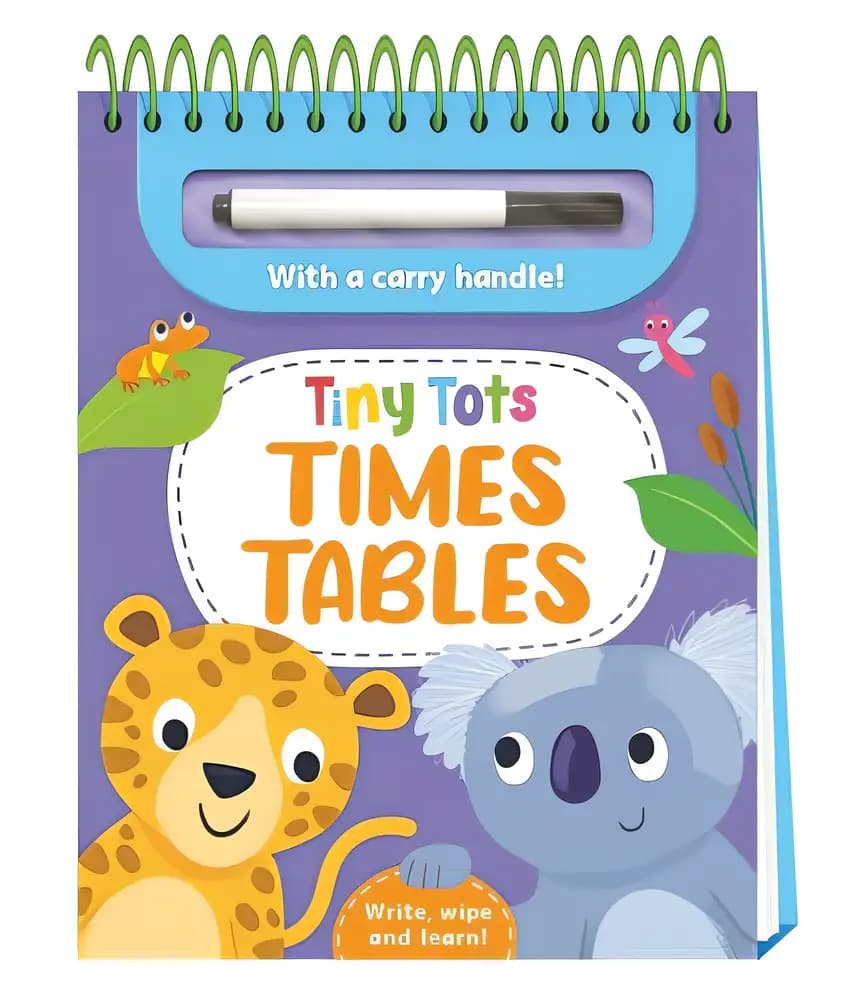
Tiny Tots Times Tables: Write, wipe and learn
#4 in Tiny Tots Learning Series
What’s inside...
Tiny Tots Times Tables is an interactive educational book designed to help young children grasp the basics of multiplication. With a write-and-wipe format, it encourages repeated practice and engagement with numbers. It is visually appealing and designed specifically for young learners. Boy, Snow, Bird is a novel by Helen Oyeyemi about a woman named Boy Novak who moves to Flax Hill, Massachusetts and becomes involved in the lives of a local craftsman, Arturo Whitman, and his daughters, Snow and Bird. The novel explores themes of identity and family dynamics, as Boy is forced to re-evaluate her perceptions of Arturo's family after the birth of her daughter, Bird. The book is known for its sparkling wit and vibrancy, and it confirms Helen Oyeyemi’s status as a dynamic literary voice.
Discussion points
What patterns can you find in the times tables that make them easier to remember?
Which times table do you find the most challenging, and why?
How do you think learning these times tables will help you in everyday life?
Can you come up with a fun story that includes some of the multiplication facts we learned today?
If you could teach a friend the times tables, how would you do it to make it fun?
Tip: Role play these questions
Use real-life examples to make the times tables relatable, like counting apples in a basket or groups of toys.
Encourage your child to draw or use physical objects to visualize multiplication problems.
Praise efforts rather than just correct answers to boost your child’s confidence in math.
Relate the importance of multiplication in daily tasks like cooking or shopping to show practical applications.
Turn learning into a game: challenge your child to a 'times table speed test' or play multiplication fact bingo.
Key lessons
Example Lesson: Building foundational math skills
Explanation: The book uses engaging activities and visual aids to introduce young readers to basic times tables.
Real-World Application: These foundational skills help children in solving everyday mathematical problems, enhancing their ability to think logically and solve problems efficiently.
Example Lesson: Encouraging practice and repetition
Explanation: With the write and wipe format, children are encouraged to practice problems multiple times which reinforces their learning.
Real-World Application: This habit of practice and repetition can be applied to any learning scenario, fostering a growth mindset and persistence in the face of challenges.
Example Lesson: Developing fine motor skills and hand-eye coordination
Explanation: The physical act of writing and wiping in the book helps in the development of fine motor skills and coordination.
Real-World Application: These skills are crucial for other everyday activities such as tying shoes, buttoning clothes, and writing with a pencil.
Example Lesson: Building confidence with numbers
Explanation: By mastering simple times tables through interactive activities, children build confidence in their mathematical abilities.
Real-World Application: This confidence can encourage them to explore more complex mathematical concepts and enjoy math-related activities, both academically and in play.
Example Lesson: Promoting independent learning
Explanation: The self-guided nature of the activities allows children to learn at their own pace, promoting autonomy in their learning process.
Real-World Application: This autonomy can foster a lifelong love of learning and self-motivation, qualities that are beneficial throughout schooling and adulthood.