
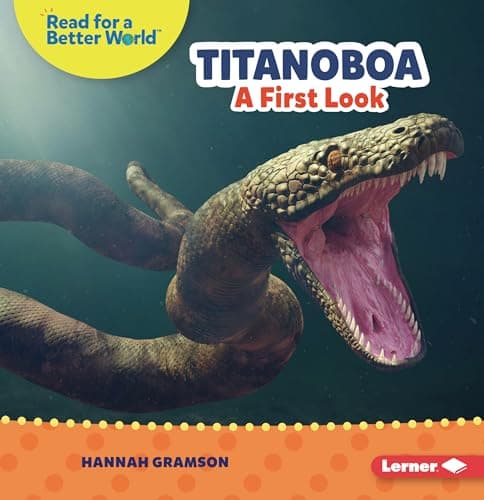
Titanoboa: A First Look (Read about Prehistoric Beasts (Read for a Better World ™))
Read about Prehistoric Beasts (Read for a Better World) Series
What’s inside...
This non-fiction early reader introduces children to Titanoboa, the largest snake ever discovered. Using simple language, photographs, and artist renderings, the book explains where Titanoboa lived, what it ate, how scientists uncovered its fossils in Colombia’s Cerrejón coal mine, and what its discovery tells us about Earth’s warm, post-dinosaur environment. Each short chapter blends vivid facts with critical-thinking questions that invite young readers to imagine life in the Paleocene rainforest and to compare Titanoboa with modern snakes.
Series reading
Non-Sequential
Age
6-9
Length
24 pages, Paperback
Text complexity
Discussion points
Why do scientists study ancient animals like Titanoboa?
How did Earth’s warmer climate help Titanoboa grow so large?
What clues tell us what Titanoboa ate?
How can learning about extinction help protect animals today?
Tip: Role play these questions
Create a mini-dig with sandbox fossils to reenact discovery.
Visit an online museum tour and look for Titanoboa replicas.
Compare Titanoboa’s size to school-bus lengths using string outside.
Key lessons
Example Lesson: Curiosity leads to discovery
Explanation: Scientists asked questions about mysterious bones and solved the puzzle.
Real-World Application: Encourage kids to explore nature and ask ‘why’ and ‘how’ questions.
Example Lesson: Evidence matters in science
Explanation: Fossil measurements proved Titanoboa’s record-breaking size.
Real-World Application: Teach children to support statements with facts when learning or debating.
Example Lesson: Climate affects all life
Explanation: Titanoboa thrived in a warmer world and vanished as temperatures cooled.
Real-World Application: Discuss how today’s climate choices impact animals and humans.