
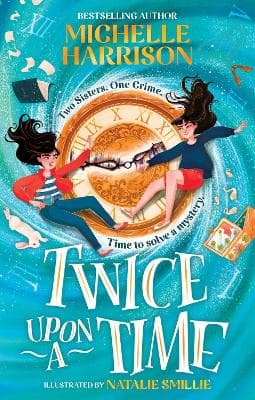
Twice Upon a Time
The Half Upon a Time Trilogy Series
What’s inside...
Can stopping time solve a murder? This delicious mystery adventure follows the Morrow twins, Merry and Spike, as they arrive at the dusty old Fox House for their holidays. Expecting boredom, they instead find themselves embroiled in a series of mysteries involving a missing woman, a baby left on the doorstep, and a locked study. As they delve deeper, they discover their own secret ability to stop time. Can their unique powers help them solve a decades-old crime? Written by award-winning author Michelle Harrison, this story is perfect for fans of Robin Stevens and Cressida Cowell.
Series reading
Non-Sequential
Age
9-12
Length
334 pages
Text complexity
Character compass
Jack
May
Phillip
The Wicked Queen
Discussion points
What did you think about the way the story ended? How would you have ended it if you were the author?
How did the main character change from the beginning to the end of the story? What caused those changes?
Can you think of a time when you felt similar to the main character? What happened and how did you feel?
What were some of your favorite parts of the book? Why did those moments stand out to you?
If you could ask the author one question about the book, what would it be?
Tip: Role play these questions
Encourage your child to reflect on the story by asking them to relate the events or characters to their own experiences.
Use pauses after each question to give your child time to think and express their thoughts fully.
Show genuine interest in their responses to foster a deeper discussion and encourage critical thinking.
Rephrase their answers or thoughts into new questions to keep the conversation flowing and delve deeper into the story's themes.
Praise your child for their insights and contributions to the discussion to boost their confidence and engagement.
Key lessons
Example Lesson: The power of teamwork
Explanation: In 'Twice Upon a Time', characters come together to solve challenges, demonstrating that cooperation can lead to success.
Real-World Application: Children can apply this lesson by working together with peers on school projects or during play, learning the importance of collaboration.
Example Lesson: The significance of honesty
Explanation: The story portrays characters facing consequences for dishonesty and rewards for truthful behaviors, emphasizing honesty's value.
Real-World Application: This encourages children to practice truthfulness in their daily interactions with family and friends, fostering trust and integrity.
Example Lesson: Resilience in the face of adversity
Explanation: Characters in the book encounter setbacks, yet they persevere and overcome obstacles, showcasing resilience.
Real-World Application: Children learn to not give up when facing difficulties in their studies, sports, or relationships, understanding that perseverance leads to personal growth.
Example Lesson: Importance of creativity
Explanation: The book highlights how characters use their imagination to solve problems, illustrating the benefits of creative thinking.
Real-World Application: This lesson can inspire children to use their imagination in play and learning, helping them to see innovative solutions in real-life situations.
Example Lesson: Empathy and understanding
Explanation: Through interactions between characters, the story teaches the value of empathy by showing the positive outcomes of understanding others' feelings.
Real-World Application: This can guide children to be more empathetic towards classmates and siblings, which can improve their social interactions and emotional intelligence.