
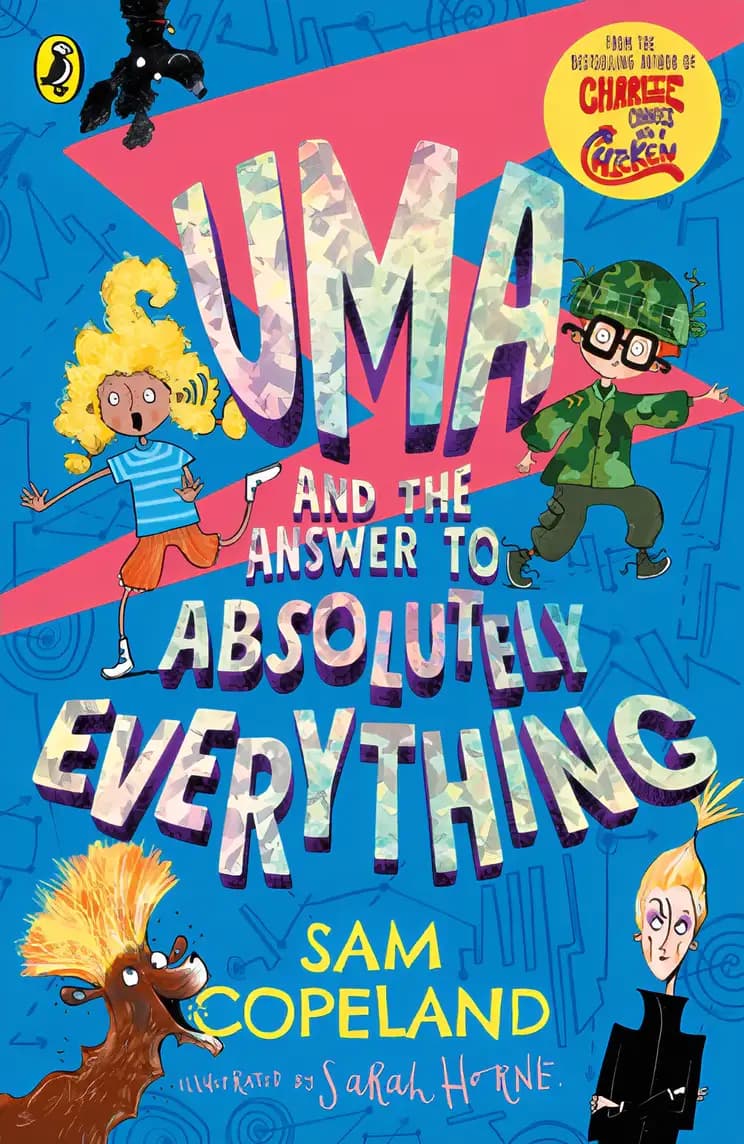
Uma and the Answer to Absolutely Everything
#1 in Uma Series
What’s inside...
Uma Gnudersonn is struggling with many questions since her mum died, including how to save her home from being sold and whether her dad will ever speak again. When she discovers Athena, a genius artificial intelligence, Uma suddenly has access to every answer she can imagine. With Athena's help, Uma plans to save her home and help her father, but she must also confront a sinister inventor determined to reclaim Athena. Along the way, Uma learns that not all questions have answers.
Character compass
Uma Gnuderson
Answer-Bot
Discussion points
What do you think Uma learned from her adventures with Athena?
How did Uma's relationship with her father change throughout the story?
If you had a device like Athena, what questions would you ask it and why?
What do you think is the importance of friendship as shown in the book?
How do you think Uma handled her challenges, and what would you do differently if you were in her shoes?
Tip: Role play these questions
Encourage your child to put themselves in Uma's shoes, imagining how they would feel and react in similar situations. Use examples from the book to discuss problem-solving and the importance of asking for help when needed. Highlight the value of curiosity and continuous learning as shown through Uma's interactions with Athena. Discuss the ethics of technology use in everyday life, considering both its benefits and potential challenges. Engage in a creative activity, like inventing a gadget or solving a simple problem, to deepen understanding of the story’s themes.
Key lessons
Example Lesson: The importance of friendship and teamwork
Explanation: In the story, Uma teams up with her friends to solve various challenges, highlighting the value of working together and supporting each other.
Real-World Application: Children can apply this lesson by collaborating with classmates on school projects or working together with siblings at home, teaching them the significance of cooperation and camaraderie.
Example Lesson: Critical thinking and problem-solving
Explanation: Uma uses her wit and the help of a super-intelligent AI to navigate complex scenarios, which showcases the use of critical thinking and inventive problem-solving strategies.
Real-World Application: This encourages children to approach their problems creatively, whether figuring out a puzzle, resolving conflicts, or making decisions.
Example Lesson: The value of curiosity and asking questions
Explanation: The narrative drives home the importance of curiosity, as Uma's quest for answers leads to adventure and growth.
Real-World Application: Children are inspired to explore the world around them and ask questions about how things work, fostering a lifelong love for learning and discovery.
Example Lesson: Dealing with loss and embracing change
Explanation: Uma deals with personal loss and change throughout the book, which is portrayed with sensitivity and realism, teaching resilience.
Real-World Application: This lesson can help children understand and accept changes in life, such as moving to a new place or coping with the loss of a loved one, and to find positive ways to adapt.
Example Lesson: Responsibility towards technology and ethical decision-making
Explanation: As Uma interacts with advanced AI technology, the story explores themes of responsibility and the ethics of technology usage.
Real-World Application: This lesson can guide children in understanding the importance of using technology wisely and ethically, such as being responsible on the internet and considering the consequences of their digital actions.