
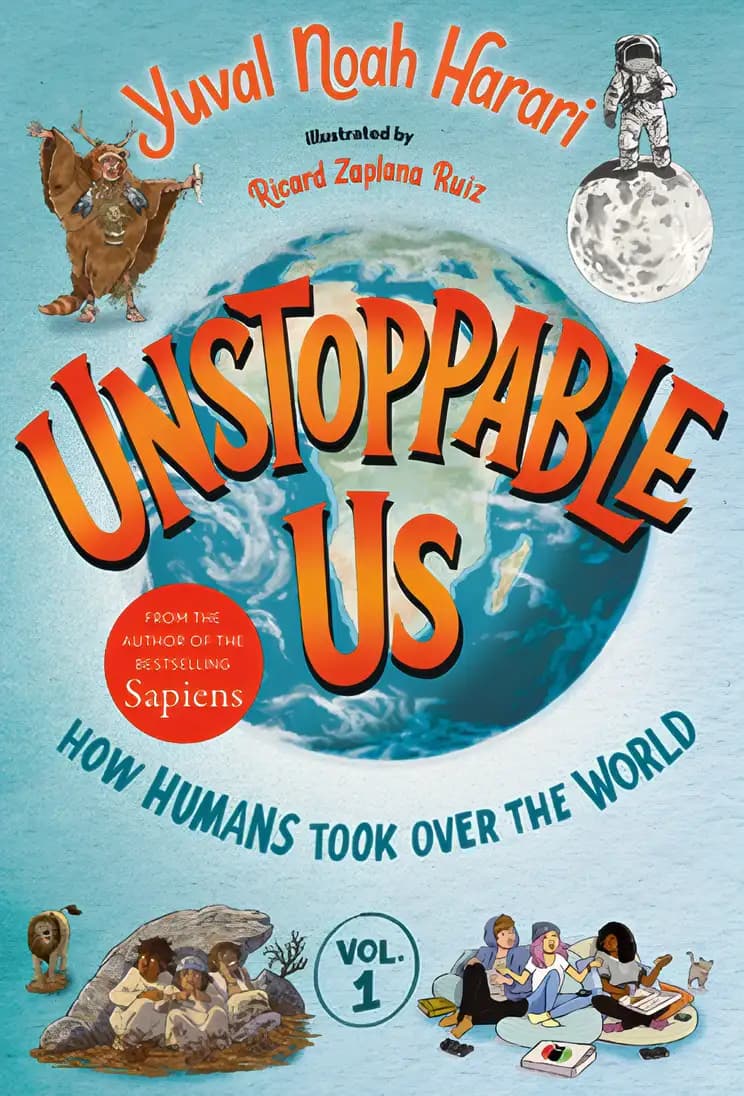
Unstoppable Us, Volume 1: How Humans Took Over the World
#1 of 3 in Unstoppable Series
What’s inside...
From world-renowned historian and philosopher Yuval Noah Harari, comes an exciting, illustrated book for middle-grade readers exploring the early history of humankind. Discover the remarkable journey of human evolution from making fire and using stars as guides to cooking with microwaves and landing on the moon. This true story, filled with maps, timelines, and full-color illustrations, reveals how humans became the most dominant species on the planet. NEW YORK TIMES BESTSELLER • From world-renowned historian and philosopher Yuval Noah Harari, the bestselling author of Sapiens, comes an exciting, illustrated book for middle school readers that looks at the early history of humankind. A New York Times Best Book of the Year. 'Gripping and thought-provoking.' — The New York Times. Even though we’ll never outrun a hungry lion or outswim an angry shark, humans are pretty impressive—and we’re the most dominant species on the planet. So how exactly did we become 'unstoppable'? The answer to that is one of the strangest tales you’ll ever hear. And it’s a true story! From learning to make fire and using the stars as guides to cooking meals in microwaves and landing on the moon, prepare to uncover the secrets and superpowers of how we evolved from our first appearances on Earth millions of years ago. Acclaimed author Yuval Noah Harari has expertly crafted an extraordinary story of how humans learned to not only survive but also thrive on Earth, complete with maps, a timeline, and full-color illustrations that bring his dynamic, unputdownable writing to life.
Discussion points
What do you think inspired early humans to create tools and communities?
How do you feel about the ways humans have adapted and changed the world over time?
What qualities do you think make humans unstoppable?
Can you think of any modern inventions that have changed how we live, similar to early human innovations?
How can we use our abilities to make positive changes in the world?
Tip: Role play these questions
Start by sharing your own thoughts on human innovation and ask your child to compare their ideas with yours.
Encourage your child to think about how they would use their own skills to solve a problem, linking it back to how early humans might have thought.
Discuss the importance of teamwork and community in achieving big changes, drawing parallels to examples in the book.
Ask your child to draw or write about an invention they wish existed and discuss how it could help people.
Praise your child for their insights and encourage them to ask questions, which can lead to deeper understanding and engagement.
Key lessons
Example Lesson: The power of cooperation
Explanation: The book illustrates how early humans collaborated and worked together, which was key to their survival and success.
Real-World Application: Children can learn the importance of teamwork and cooperation in accomplishing tasks and achieving goals in school projects or sports.
Example Lesson: Innovation and creativity
Explanation: Harari discusses how human beings used their ability to think creatively and come up with innovative solutions to adapt and thrive.
Real-World Application: This encourages children to use their imagination and creativity in problem-solving, whether in academic challenges or personal projects.
Example Lesson: Understanding and accepting differences
Explanation: The story explores how humans have evolved in diverse environments leading to a variety of cultures and perspectives.
Real-World Application: Children can apply this lesson by learning to appreciate and respect different cultures and viewpoints among their peers.
Example Lesson: The impact of storytelling
Explanation: Harari highlights how storytelling has been a powerful tool for humans to share knowledge and values across generations.
Real-World Application: This can inspire children to value and engage in storytelling, improving their communication skills and understanding of the world.
Example Lesson: Questioning and critical thinking
Explanation: The narrative encourages questioning the world around us and not accepting information at face value, promoting a culture of inquiry and reflection.
Real-World Application: Children can be encouraged to ask questions about how things work, fostering a habit of critical thinking and continuous learning.