
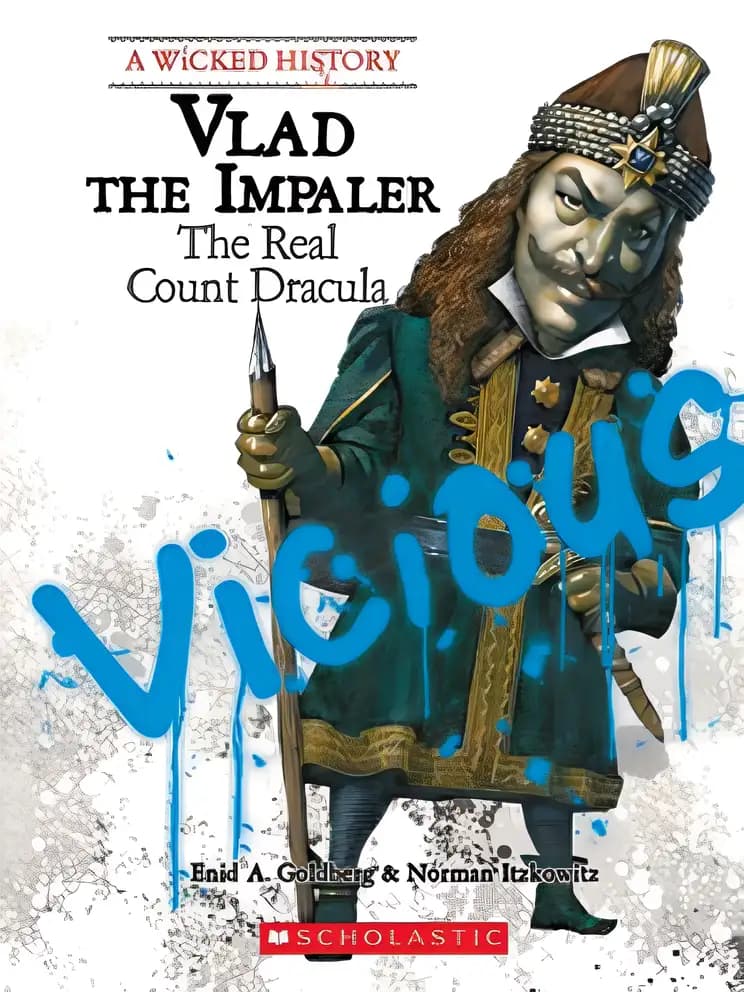
Vlad the Impaler: The Real Count Dracula (A Wicked History)
#1 in A Wicked History Series
on Goodreads (470)
What’s inside...
Explore the life of Vlad 'the Impaler' Dracula, the fifteenth-century Romanian prince who served as a model for Bram Stoker's infamous vampire. The wicked ways of some of the most ruthless rulers to walk the earth are revealed in these thrilling biographies (A Wicked History) about men and women so monstrous, they make Frankenstein look like a sweetheart.
Character compass
Vlad The Impaler
Vlad Dracul
Mehmed Ii
Radu The Handsome
Discussion points
What do you think motivated Vlad the Impaler's actions, and how do different perspectives influence our understanding of historical figures?
How do the actions of Vlad the Impaler show the impact of leadership on a community or nation?
In what ways do legends and historical facts blend together in the story of Vlad the Impaler, and why do you think people are fascinated by his story?
What could be some reasons for the different portrayals of Vlad the Impaler in history and popular culture?
How might understanding the true history behind a legendary figure like Dracula change our perception of other historical tales or figures?
Tip: Role play these questions
Encourage your child to express their thoughts by asking what surprised them the most about Vlad the Impaler's story.
Discuss the difference between historical facts and legends, highlighting how stories can change over time depending on who tells them.
Facilitate a discussion on the moral decisions in leadership by comparing Vlad’s actions to modern-day leaders, encouraging critical thinking.
Explore motivations behind actions, asking your child how they might have felt or acted in similar historical circumstances, promoting empathy and understanding.
Key lessons
Example Lesson: The importance of historical accuracy
Explanation: The book educates on the real-life figure Vlad the Impaler, distinguishing the truths from the myths associated with his legend as Dracula.
Real-World Application: Children learn the value of researching and understanding history accurately, rather than accepting popular myths at face value. This helps in building critical thinking skills.
Example Lesson: Understanding the impact of leadership
Explanation: Through Vlad's complex role as a leader, the book explores how his decisions impacted his country and people, both positively and negatively.
Real-World Application: This lesson can help children understand that leadership comes with responsibilities, and their choices can affect others around them.
Example Lesson: Moral complexities
Explanation: The narrative delves into the moral decisions made by Vlad, highlighting that historical figures and their choices are often not just good or bad.
Real-World Application: Children can learn to appreciate the complexity of moral choices and understand that real-life decisions often require careful thought and consideration.
Example Lesson: The consequences of actions
Explanation: The book presents the long-term consequences of Vlad’s actions for his region and people.
Real-World Application: This teaches children that actions have consequences that extend beyond immediate outcomes, encouraging them to think long-term.