
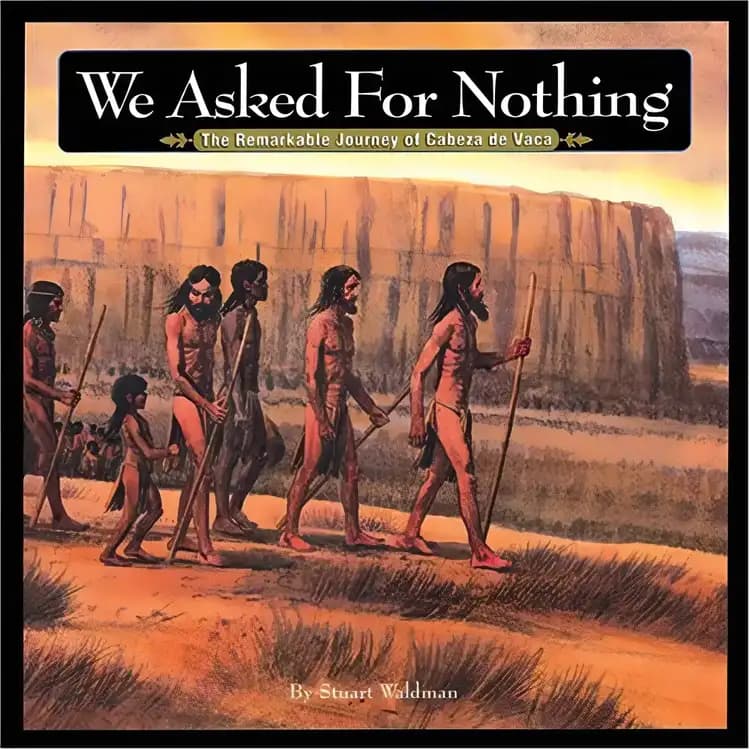
We Asked for Nothing: The Remarkable Journey of Cabeza de Vaca (Great Explorers)
Books for Young Explorers Series
What’s inside...
An account of the travels of Spanish explorer Cabeza de Vaca through Texas and Mexico from 1528 through 1536, looking particularly at his relations with the native people with whom he shared his journeys. The explorer who discovered his own humanity. In 1528, the conquistador Alvar Nunez Cabeza de Vaca escaped a hostile reception in Florida only to be shipwrecked off the coast of Texas. For the next eight years, he lived among the native tribes of the Southwest while he journeyed towards the safety of the Spanish settlements in Mexico. He and three companions survived starvation, sickness and slavery thanks to the generosity of native peoples along the way. When Cabeza de Vaca finally reached the Spanish, he was a changed man and led the struggle against the feudal-like exploitation of the New World populations. Stuart Waldman tells the fascinating story of two one covering 2,500 miles through unexplored territory, the other the transformation of a man's heart. Excerpts from Cabeza de Vaca's journals make the reader's immersion into this mystifying world complete. The gatefold map allows the reader to follow the journey while reading.
Series reading
Non-Sequential
Age
9-13
Length
48 pages
Text complexity
Character compass
ÁLvar NúñEz Cabeza De Vaca
Alonso Del Castillo
AndréS Dorantes De Carranza
Estevanico
PáNfilo De NarváEz
Discussion points
What qualities do you think made Cabeza de Vaca a great explorer?
How do you think Cabeza de Vaca felt during his journey, and what would you have done in his place?
What are some challenges that Cabeza de Vaca faced, and how did he overcome them?
Why is it important to learn about the history and experiences of explorers like Cabeza de Vaca?
What lessons can we learn from Cabeza de Vaca's journey that can be applied to challenges we face today?
Tip: Role play these questions
Encourage your child to imagine themselves in Cabeza de Vaca’s situation, discussing how they would have felt and acted.
Discuss the values like courage, perseverance, and leadership exhibited by Cabeza de Vaca and relate them to everyday situations your child may encounter.
Use a globe or map to trace the route Cabeza de Vaca might have taken, making the story more engaging and giving geographical context.
Research together more about the time period and other explorers of that era to enrich the conversation and provide a deeper understanding of Cabeza de Vaca’s world.
After reading, ask your child to draw their favorite scene or write a short journal entry from the perspective of Cabeza de Vaca.
Key lessons
Example Lesson: Resilience in the face of adversity
Explanation: Cabeza de Vaca's journey is marked by numerous challenges, from shipwrecks to navigating unfamiliar lands. His ability to persevere showcases the significance of resilience.
Real-World Application: Children can learn to remain resilient when facing difficulties in school or in personal challenges, understanding that persistence can lead to overcoming obstacles.
Example Lesson: Cultural understanding and respect
Explanation: Throughout his explorations, Cabeza de Vaca encounters various indigenous tribes. His interactions are based on respect and curiosity, which highlight the importance of embracing cultural diversity.
Real-World Application: This can help children appreciate and respect people from different backgrounds they meet in their everyday life, fostering a more inclusive attitude.
Example Lesson: Adaptability
Explanation: Cabeza de Vaca adapts to new environments and situations throughout his travels. This adaptability is crucial to his survival and success.
Real-World Application: Children can apply this lesson by learning to adjust to new situations, whether it’s moving to a new school, dealing with changes at home, or simply handling unexpected changes in plans.
Example Lesson: Leadership and teamwork
Explanation: Despite the hardships, Cabeza de Vaca often took on a leadership role, guiding and working with others to navigate the challenges faced.
Real-World Application: This story can encourage children to take initiative in group settings, work collaboratively, and support their peers, skills that are important in both academic and social settings.
Example Lesson: Importance of curiosity and exploration
Explanation: Cabeza de Vaca's journey was driven by a quest for knowledge and exploration, showing how curiosity can lead to significant discoveries and personal growth.
Real-World Application: Children can be encouraged to explore new topics, ask questions, and engage deeply in their learning to foster a lifelong love of discovery.