
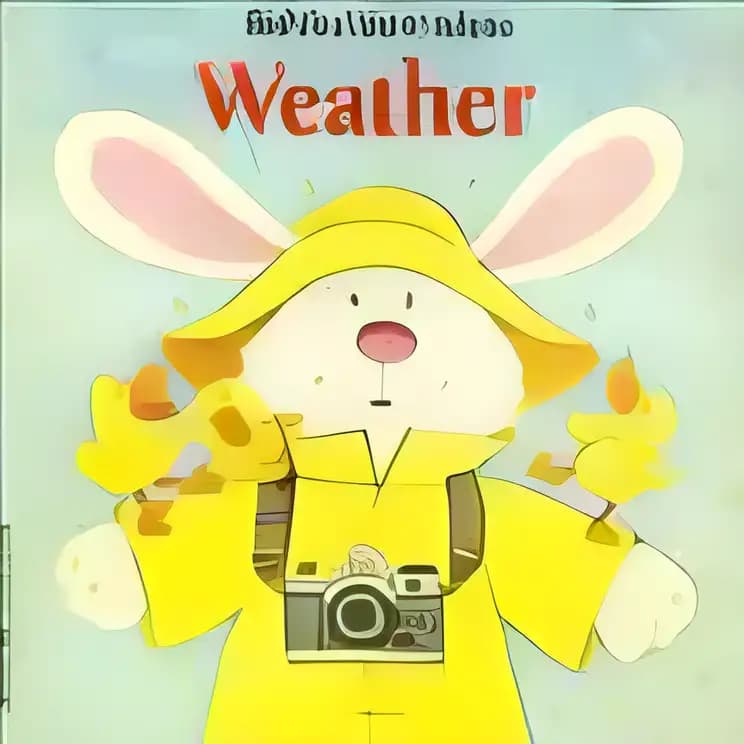
Weather (First-Start Science)
First-Start Easy Reader Series
What’s inside...
Weather (First-Start Science) by Melissa Setzoff is an introductory guide for young readers exploring the world of weather. The book simplifies complex meteorological concepts for a younger audience, covering topics such as temperature, wind, humidity, and precipitation. It explains the water cycle, cloud types, weather patterns, and extreme weather events like thunderstorms and hurricanes. The book uses colorful illustrations and simple experiments to encourage children to observe and understand weather, fostering an early appreciation for science and the natural world.
Series reading
Non-Sequential
Age
5-7
Length
32 pages
Text complexity
Discussion points
What kind of weather do you like the best and why?
Can you think of a time when the weather changed our plans? What happened?
How do different kinds of weather affect the way we dress or the activities we do?
Why do you think it's important to know about different weather conditions?
If you could control the weather for a day, what would the weather be like?
Tip: Role play these questions
Use visual aids like weather charts or illustrations from the book to make the discussion more interactive.
Encourage your child to draw or describe their favorite weather scenario inspired by the book.
Relate the weather topics from the book to real-life situations or family events that were influenced by weather.
Ask your child to predict the weather for the next day and compare their predictions with actual weather conditions to nurture observational skills.
Key lessons
Example Lesson: Understanding basic weather conditions
Explanation: The book introduces children to different types of weather, such as sunny, rainy, and snowy conditions, teaching them the characteristics of each.
Real-World Application: Children can apply this knowledge in daily life by choosing appropriate clothing and activities based on the weather, fostering independence.
Example Lesson: Learning the water cycle
Explanation: The narrative explains the process of evaporation, condensation, and precipitation, simplifying these concepts for young minds.
Real-World Application: This understanding helps children grasp why and how rain occurs, allowing them to connect their observations with scientific explanations.
Example Lesson: Observational skills
Explanation: The book encourages children to watch the sky and notice weather changes, promoting curiosity and attention to detail.
Real-World Application: Enhanced observational skills can lead to a greater appreciation of the natural world and encourage scientific thinking and inquiry.
Example Lesson: Importance of caring for the environment
Explanation: Through the discussion of natural phenomena, the book subtly emphasizes the role weather plays in the ecosystem.
Real-World Application: This lesson teaches children the significance of environmental conservation and can encourage eco-friendly behaviors like recycling and saving water.
Example Lesson: Safety awareness during different weather conditions
Explanation: The book offers safety tips for various weather scenarios, such as seeking shelter during a storm.
Real-World Application: Children learn to understand and react appropriately to weather warnings, which is crucial for their safety in potentially dangerous situations.