
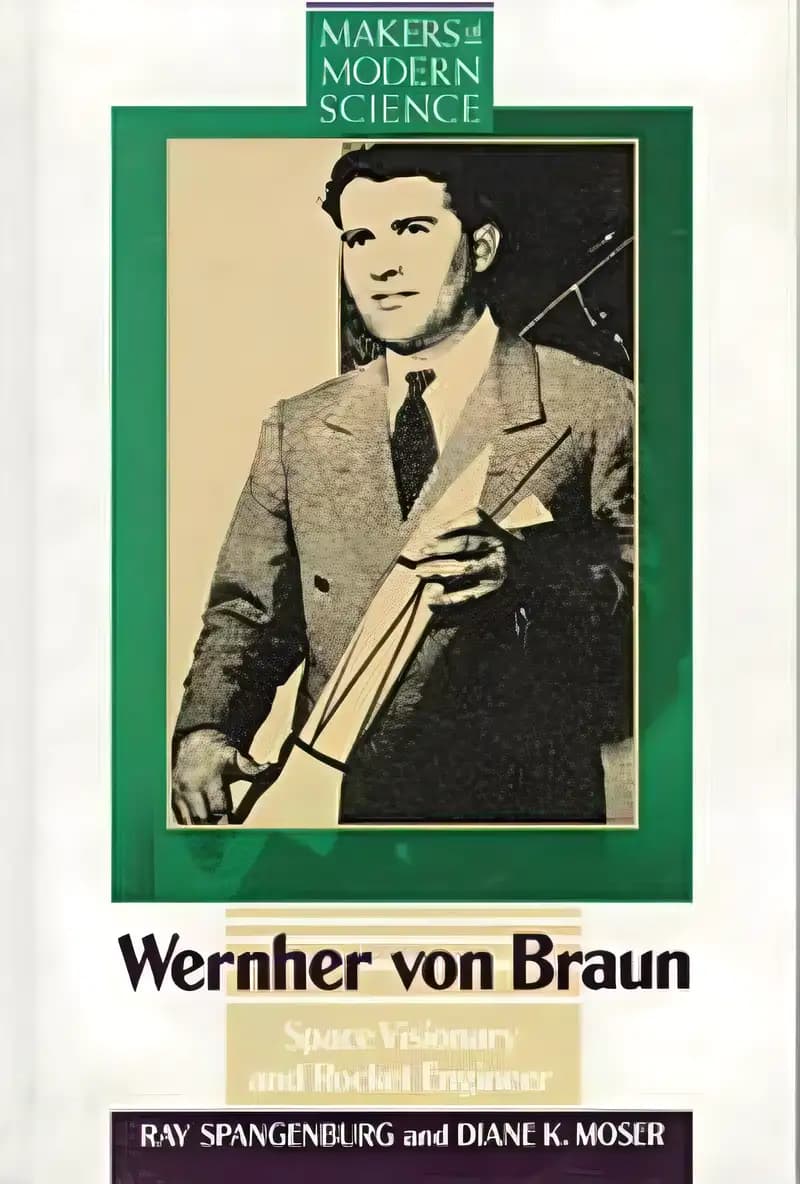
Werhner Von Braun: Space Visionary and Rocket Engineer (Makers of Modern Science)
Makers of Modern Science Series
on Goodreads (14)
What’s inside...
This biography series, aimed at young adults, profiles important modern-era scientists. The volumes focus on the lives of those men and women who, in the 19th and 20th centuries, made the greatest contributions to scientific knowledge. Each book looks at a scientist - or group of scientists - whose work had a major impact on a particular field. In simple prose, free of technical jargon, each scientist's achievements are discussed, including the scientific principles underlying his or her work. The human drama of scientific work, conveying the excitement and frustration of research, as well as the exhilaration and rewards of discovery, are also depicted. This work provides a profile of Werner von Braun, the designer of rocket engines who developed the V2 rocket (1938) and went on to play a major role in America's first success in space, the satellite 'Explorer I', in 1958.
Series reading
Non-Sequential
Age
12-15
Length
144 pages
Text complexity
Character compass
Wernher Von Braun
Discussion points
What inspired Werhner von Braun to become involved in rocket science and space exploration?
How do you think von Braun's inventions have changed the way we view and explore space today?
What challenges do you think von Braun faced while working on his projects and how did he overcome them?
If you had the opportunity to meet Werhner von Braun, what questions would you ask him about his life and career?
How can we use von Braun's dedication and innovations as inspiration in our own lives?
Tip: Role play these questions
Start the conversation by sharing a brief overview of von Braun’s achievements to pique your child’s interest.
Relate the space exploration themes to your child’s everyday experiences, such as discussing the science behind rockets using simple physics concepts.
Encourage your child to think critically by asking them how they would solve a problem if they were in von Braun's position.
Draw parallels between the perseverance shown by von Braun and challenges your child may face in their own endeavors.
Highlight the importance of curiosity and lifelong learning, using von Braun’s career as an example.
Key lessons
Example Lesson: Perseverance and dedication
Explanation: The book describes Werner von Braun's relentless pursuit of space exploration despite numerous challenges.
Real-World Application: Children can learn the importance of persisting and working hard towards their dreams, regardless of obstacles they face in school or hobbies.
Example Lesson: Importance of education and learning
Explanation: Von Braun's extensive knowledge in physics and mathematics enabled his advancements in rocket technology, emphasizing the role of education in achieving goals.
Real-World Application: This can encourage children to value their education and be enthusiastic about learning new subjects at school.
Example Lesson: Moral responsibility in science
Explanation: The narrative addresses the ethical considerations of Von Braun’s work, particularly during World War II, teaching readers about the complexities of moral choices in science.
Real-World Application: Children can apply this to making ethical decisions in everyday life, understanding the impact their choices can have on others.
Example Lesson: Teamwork and collaboration
Explanation: The book highlights how Von Braun worked with a team to accomplish significant scientific achievements, showcasing the power of collaborative effort.
Real-World Application: This reinforces the value of teamwork in school projects or in sports, teaching children the benefits of working together towards a common goal.
Example Lesson: Curiosity and innovation
Explanation: Von Braun's story inspires curiosity and the drive to innovate, as he constantly sought new solutions and improvements in rocket technology.
Real-World Application: Children are encouraged to think creatively and ask questions in their daily explorations and problem-solving activities.