
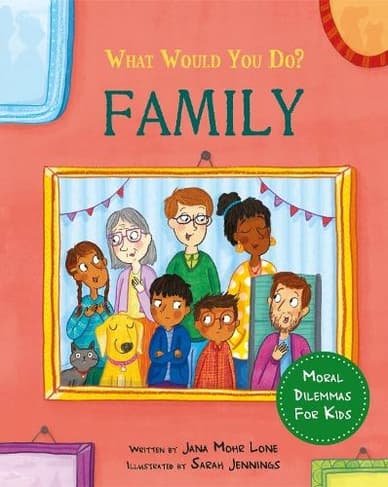
What would you do?: Family: Moral dilemmas for kids
#2 of 3 in What Do You Do When….? Series
illustrations by
What’s inside...
A thoughtful exploration of family-centered moral dilemmas presented through scenarios that challenge kids to think critically and empathetically about choices and consequences.
Discussion points
What would you do if you saw someone being treated unfairly? How would you feel?
Can you think of a time when you had to choose between right and wrong? What did you do?
How do you decide if something is fair or not? What rules do you use?
If you had the power to change one unfair situation, what would it be and why?
How do you think your actions affect others when you are faced with a moral choice?
Tip: Role play these questions
Listen actively to your child’s responses without interrupting, showing that their thoughts and opinions are valued.
Encourage your child to elaborate on their answers by asking follow-up questions like, 'Can you tell me more about that?' or 'Why do you think that?'
Connect the dilemmas in the book to real-life situations your child might encounter, making the discussion more relatable and impactful.
Highlight the importance of empathy by discussing how the characters might feel in various scenarios and asking your child how they would feel in the same situation.
Finish the conversation by affirming their thoughtful responses, boosting their confidence in making moral decisions.
Key lessons
Example Lesson: Empathy and Understanding
Explanation: The book presents various family scenarios where kids face moral dilemmas, requiring them to consider different perspectives.
Real-World Application: Children learn to understand and empathize with others' feelings and viewpoints, improving their social interactions and emotional intelligence.
Example Lesson: Decision Making
Explanation: Each dilemma challenges the readers to weigh options and predict outcomes, urging them to think carefully before making decisions.
Real-World Application: This skill is fundamental in everyday choices and helps children become more independent and confident in their judgment.
Example Lesson: Responsibility
Explanation: Characters in the book are placed in situations where their choices affect others, highlighting the importance of responsible behavior.
Real-World Application: Children apply this to their lives by understanding the impact of their actions on their peers and family, fostering accountability.
Example Lesson: Integrity
Explanation: The book encourages sticking to one’s principles even when faced with tough choices.
Real-World Application: Kids learn the value of honesty and moral courage, principles they can uphold in academic and social settings.
Example Lesson: Conflict Resolution
Explanation: The story provides examples where characters must resolve conflicts amicably.
Real-World Application: Teaches children effective communication and problem-solving skills crucial for resolving disputes in school and at home.