
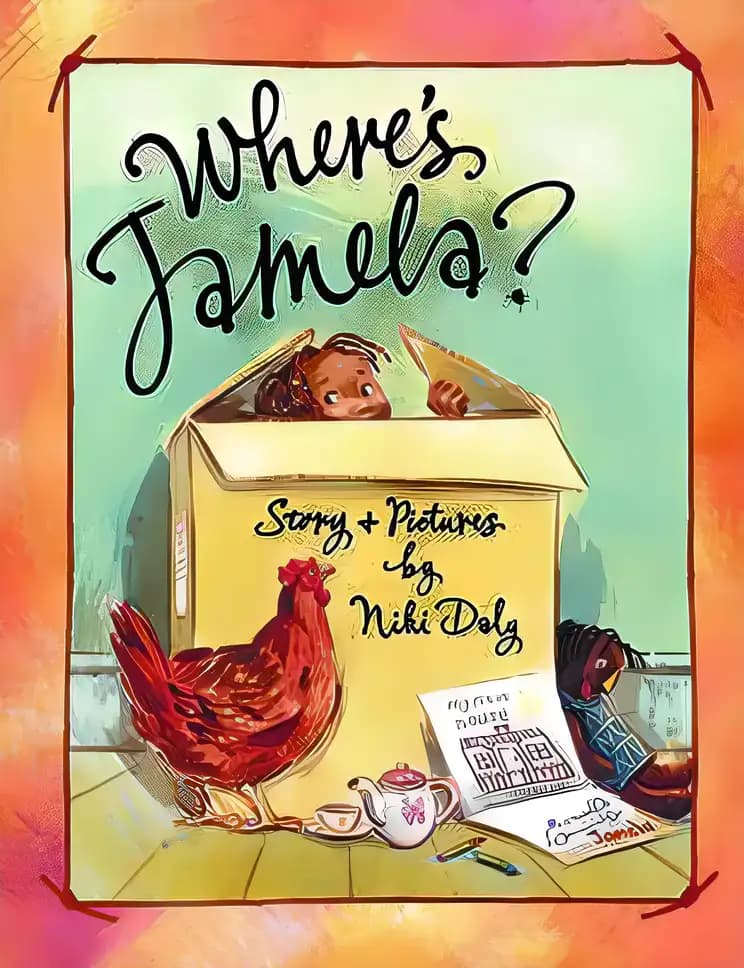
Where's Jamela?
#3 in Jamela Series
What’s inside...
Mama and Gogo are extremely excited about moving to a new house, while Jamela is reluctant and wants to stay in their current home. Jamela tries to pack her belongings, but ends up packing herself in a box and falling asleep. As the moving truck is about to leave, Mama notices Jamela is missing, prompting a search that includes various characters like Mrs Zibi, Greasy Hands, and Christmas the chicken. Eventually, Jamela learns to appreciate the new home and realizes there's no place like home.
Character compass
Jamela
Mama
Gogo
Discussion points
Why do you think Jamela wrapped her chicken in beautiful fabrics? What does that tell us about her?
How did Jamela's community help her in the story? Can you think of a time when our community helped us?
What emotions did Jamela feel throughout the book and what made her feel that way?
How did the story change after Jamela’s chicken disappeared? What would you have done if you were Jamela?
What did you learn about the culture and traditions shown in the book? Which was your favorite?
Tip: Role play these questions
Start the conversation by discussing the vibrant illustrations, asking your child what colors and patterns they notice.
Relate the story’s events to your child’s experiences by asking about times they have helped or been helped by others.
Encourage empathy by discussing how Jamela felt in different parts of the story, asking your child to imagine how they would feel in similar situations.
Use open-ended questions to allow for more exploration of the child’s thoughts and feelings about the story’s themes and characters.
Discuss the cultural elements within the book, explaining any unfamiliar terms or practices to enhance understanding and appreciation.
Key lessons
Example Lesson: Responsibility
Explanation: The story showcases Jamela's journey of taking care of her family's prize chicken, illustrating the importance of responsibility.
Real-World Application: Children can learn to handle tasks and care for things or pets at home, understanding that their actions directly affect others and themselves.
Example Lesson: Resilience
Explanation: When things don't go as planned, Jamela finds ways to cope and adapt, emphasizing the trait of resilience.
Real-World Application: Kids can apply this by learning to overcome obstacles or setbacks they face in school or play, finding alternatives and solutions.
Example Lesson: Creativity
Explanation: Jamela uses her creativity to solve problems, turning challenging situations into opportunities.
Real-World Application: Children are encouraged to use their imagination to think outside the box, whether in their playtime or while tackling school projects.
Example Lesson: Empathy
Explanation: Through her interactions, Jamela learns to understand and share the feelings of other characters.
Real-World Application: This lesson helps children develop the ability to empathize, improving their social interactions and emotional intelligence in dealing with friends and family.
Example Lesson: Community
Explanation: The book portrays a vibrant community supporting each other, highlighting the value of community interconnectedness.
Real-World Application: Children can see the importance of participating in community activities and how collaboration and support can lead to successful outcomes.