
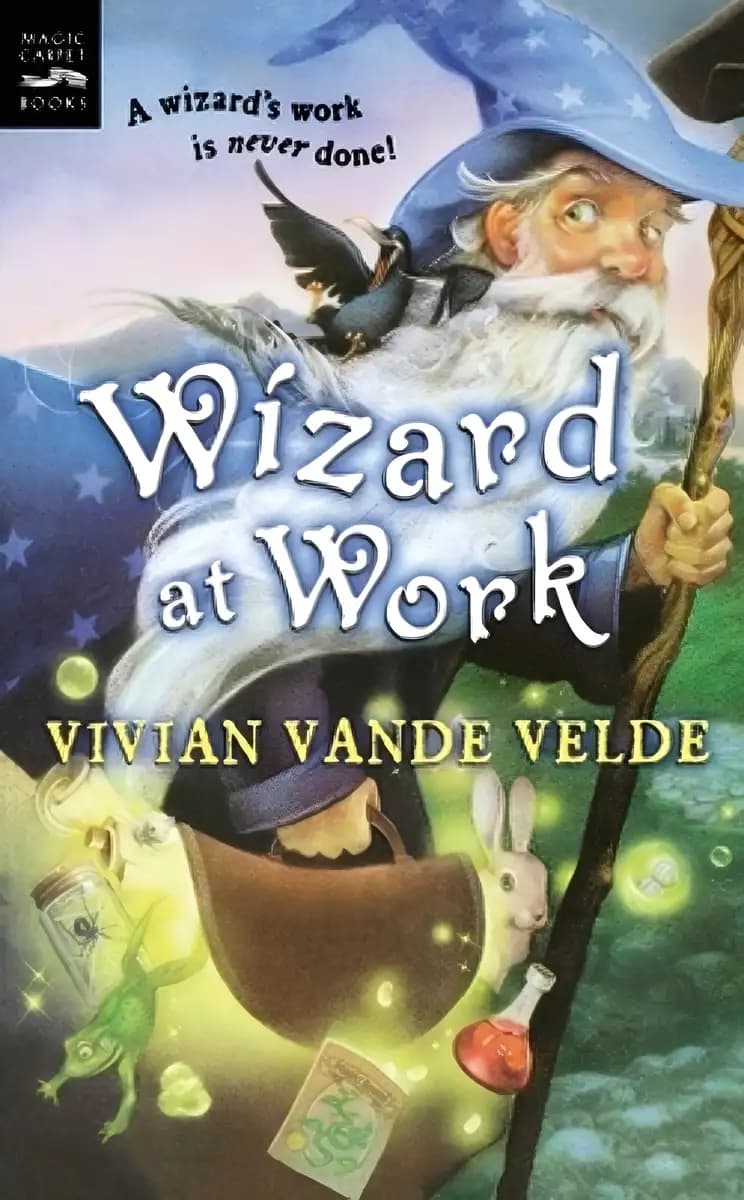
Wizard at Work
on Goodreads (443)
What’s inside...
The wizard has big summer plans: to garden, to fish, and to nap. The only thing better would be if he had someone nice to share the days with. But the only people who show up want him to rescue yet another princess, lift the usual vile curse, confront a fearsome ghost, deal with a pack of magical hooligans, harvest a crop of golden cucumbers, and on and on. . . . A wizard's work is never done!
Age
10-12
Length
144 pages
Text complexity
Character compass
The Wizard
Discussion points
What do you think is the most magical moment in the story and why?
If you could create a magical spell, what would it do and how would it help people?
How do you think the wizard feels when his magic works (or doesn’t work)?
What would you do if you met a wizard like the one in the book?
How can we use our own 'magic' (skills or talents) to help others in our daily lives?
Tip: Role play these questions
Encourage your child to imagine and describe their own magical world, taking cues from the book’s descriptions.
Discuss the moral or lesson of the story and relate it to real-life situations your child might encounter.
Ask your child to draw or craft something inspired by the book, such as a wizard’s hat or a magical creature.
Create a fun quiz for your child based on the characters and events in the book, to reinforce comprehension and memory.
Praise your child’s responses and insights to boost their confidence in expressing their thoughts and ideas.
Key lessons
Example Lesson: The importance of teamwork
Explanation: Throughout 'Wizard at Work', the characters collaborate on magical projects which demonstrate that teamwork can lead to success.
Real-World Application: Children can learn to work cooperatively on group projects at school or in sports teams, understanding that diverse skills come together to achieve a common goal.
Example Lesson: Responsibility and diligence
Explanation: The wizard takes responsibility for his spells and works diligently to correct any mishaps, showcasing the value of taking ownership and being thorough in tasks.
Real-World Application: This can encourage children to be responsible for their homework, chores, and actions, teaching them the importance of diligence and accountability.
Example Lesson: Creativity and thinking outside the box
Explanation: The wizard often uses unconventional methods to solve problems, illustrating that creative thinking can provide unique solutions.
Real-World Application: Children are encouraged to use their imagination and creativity when faced with challenges, allowing them to explore different solutions in their daily lives.
Example Lesson: The value of persistence
Explanation: When spells go awry, the wizard persistently tries again, underlining the lesson that perseverance through failure leads to eventual success.
Real-World Application: This teaches children not to give up easily whether in learning new skills, sports, or in their interpersonal relationships.