
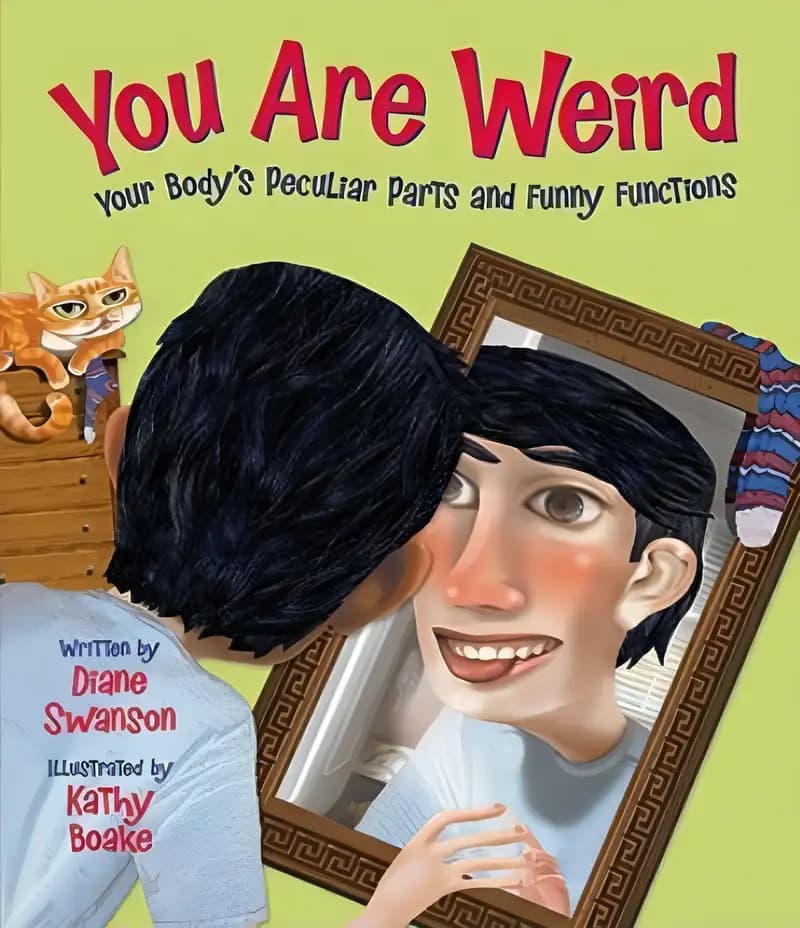
You Are Weird: Your Body’s Peculiar Parts and Funny Functions
What’s inside...
The book 'You Are Weird' explores the weird and wonderful aspects of the human body, highlighting our similarities with other members of the animal kingdom. From hairy bodies to bacteria in the mouth and oddball organs, the book answers curious questions about human anatomy and physiology using the latest scientific theories. It provides a guided tour of the body's freaky functions that make us unique, wacky, and wonderfully weird.
Age
8-12
Length
40 pages
Text complexity
Discussion points
What did you find most surprising about how our bodies work?
Which body part do you think is the funniest or weirdest, and why?
How do you think our bodies help us every day with things we don't even notice?
If you could have any superpower related to a body function, what would it be and why?
How do you feel knowing that everyone has weird and wonderful body parts?
Tip: Role play these questions
Stay positive and curious. React with fascination to your child's thoughts to make them feel comfortable sharing.
Use the illustrations in the book to point out different body parts and functions, fostering a visual connection to the text.
Encourage your child to relate personal experiences or feelings about their own body to the book's content.
Praise your child’s insights and encourage them to ask their own questions about the body.
Relate the content back to subjects they’re learning in school, like science or health, to deepen their understanding and relevance.
Key lessons
Example Lesson: Embracing uniqueness
Explanation: This book teaches children to appreciate and embrace the unique aspects of their bodies, demonstrating through humor and science that what might seem strange is actually normal and valuable.
Real-World Application: Children can apply this lesson by celebrating their own differences and those of others, promoting self-confidence and inclusivity.
Example Lesson: Understanding the human body
Explanation: Through engaging explanations about peculiar body parts and functions, the book educates children on the biological reasons behind these features, enhancing their understanding of human anatomy.
Real-World Application: This knowledge empowers children to better understand and explain how their bodies work, fostering curiosity and respect for biological sciences.
Example Lesson: Critical thinking
Explanation: By presenting weird and funny bodily functions, this book encourages children to think critically about why the human body works the way it does, and not just accept things at face value.
Real-World Application: Children learn to ask questions and seek out answers, skills that are applicable in academic settings and everyday problem-solving.
Example Lesson: Developing a sense of humor
Explanation: The book uses humor to discuss body functions, helping children appreciate the lighter side of science and learning, making education enjoyable.
Real-World Application: This lesson helps children to develop a healthy sense of humor, which can aid in social interactions and personal resilience.