
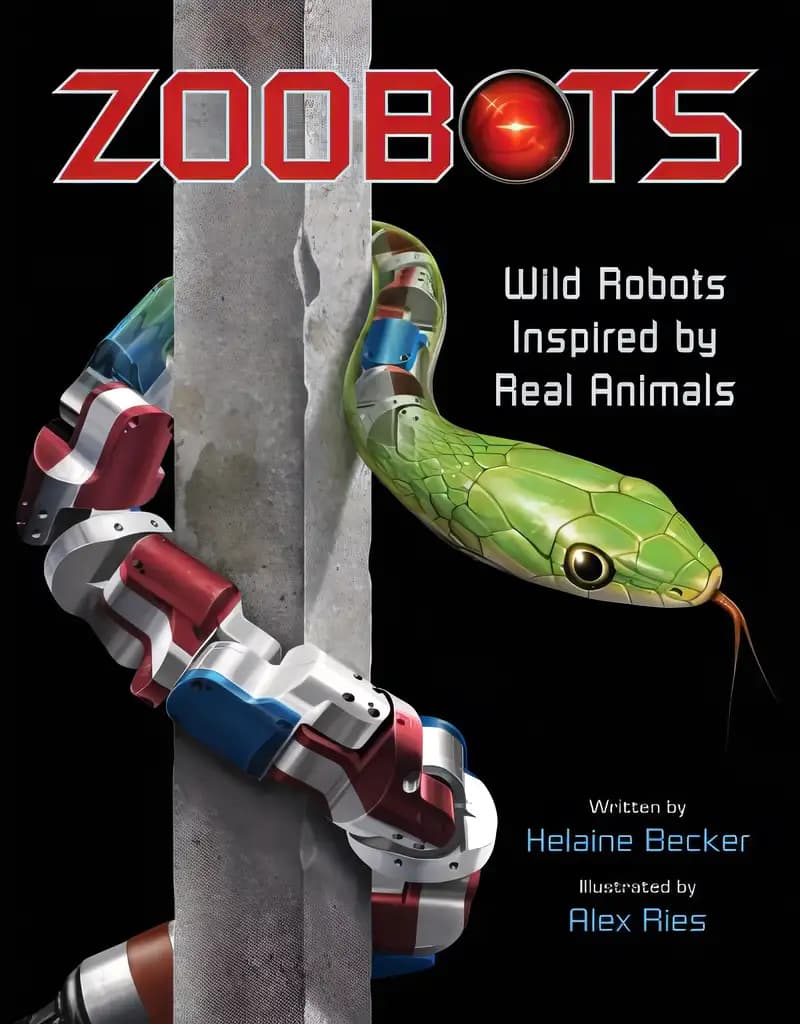
Zoobots: Wild Robots Inspired by Real Animals
What’s inside...
This book delves into the innovative world of robo-animals, also known as zoobots, where roboticists employ mechatronics to create robots that emulate the unique abilities of animals. It features detailed examples such as robots with sensitive computerized 'whiskers' for finding fire survivors, robots that can scale walls using super stickiness, and robots that deliver drugs inside the human body with microscopic whiptails. The text by Helaine Becker is comprehensive, yet clear and lively, and is complemented by vivid illustrations by Alex Ries. The book also includes a glossary and index, making it a valuable resource for classroom use in teaching technology, engineering, and inventions.
Age
8-12
Length
32 pages
Text complexity
Discussion points
How do you think robots and animals are similar or different?
Which Zoobot was your favorite and why?
Imagine you could design your own Zoobot. What animal would it mimic and what abilities would it have?
How do you think these robots could help humans and the environment?
What did you learn about the real animals that inspired these Zoobots?
Tip: Role play these questions
Before reading, ask your child what they know about robots and animals, and discuss their thoughts.
While reading, pause to examine the illustrations together, connecting the robot designs to the features of real animals.
After reading, encourage your child to draw or build their own Zoobot inspired by their favorite animal.
Discuss the importance of technology and innovation, relating it to the Zoobots and their functions described in the book.
Use the book as an opportunity to explore more about each real animal that inspired the Zoobots, promoting further learning and curiosity.
Key lessons
Example Lesson: Innovation and Creativity
Explanation: Zoobots showcases robots modeled after real animals, demonstrating the intersection of biology and technology. This encourages children to see how creativity can lead to innovative solutions.
Real-World Application: Children learn to think creatively when faced with challenges or in their play, considering unusual or innovative solutions as viable options.
Example Lesson: Importance of Nature and Robotics
Explanation: The book illustrates how robots can mimic animal behaviors and characteristics, teaching children the importance of understanding nature and technological advancements.
Real-World Application: Children can develop a greater appreciation for wildlife and learn about the role of technology in studying and protecting animals.
Example Lesson: Problem Solving
Explanation: By exploring how robots solve problems that real animals face, such as navigating different terrains, children learn about the practical applications of problem solving.
Real-World Application: This encourages children to apply problem-solving skills in their daily activities, whether it's figuring out how to build a stable structure with blocks or finding the best route on a family hike.
Example Lesson: Interdisciplinary Learning
Explanation: Zoobots integrates concepts from both biology and technology, demonstrating how different fields of study can work together.
Real-World Application: Children are encouraged to draw connections between different subjects in school, understanding that knowledge is interconnected and not isolated within single subjects.